
购物车0
产品总数:56417

| 中文名称 |
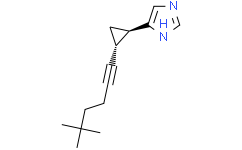
Cipralisant
|
|---|---|
| 英文名称 |
Cipralisant
|
| 英文别名 |
5-[2-(5,5-dimethylhex-1-yn-1-yl)cyclopropyl]-1H-imidazole;1H-imidazole, 4-[2-(5,5-dimethyl-1-hexyn-1-yl)cyclopropyl]-;4-(2-(5,5-dimethylhex-1-ynyl)cyclopropyl)imidazole;4-[2-(5,5-dimethylhex-1-yn-1-yl)cyclopropyl]-1H-imidazole;5-[2-(5,5-dimethylhex-1-ynyl)cyclopropyl]-1H-imidazole;Cipralisant
|
| Cas No. |
213027-19-1
|
| 分子式 |
C14H20N2
|
| 分子量 |
216.32
|
| 包装储存 |
Powder -20°C 3 years;4°C 2 years
|
| 详情描述 |
Cipralisant (GT-2331) 在体内是一种具有口服活性、低毒、有效、选择性、高亲和力的 histamine H3 receptor 的拮抗剂,在体外是 histamine H3 receptor 的激动剂,对于histamine H3 receptor,其 pKi为 9.9,对大鼠 histamine H3 receptor 的Ki为 0.47 nM。Cipralisant 有研究注意缺陷多动障碍的潜力。
|
| 产品详情 |
Cipralisant (GT-2331) 在体内是一种具有口服活性、低毒、有效、选择性、高亲和力的 histamine H3 receptor 的拮抗剂,在体外是 histamine H3 receptor 的激动剂,对于histamine H3 receptor,其 pKi为 9.9,对大鼠 histamine H3 receptor 的Ki为 0.47 nM。Cipralisant 有研究注意缺陷多动障碍的潜力。
|
|---|---|
| 生物活性 |
Cipralisant (GT-2331) is an orally active, low-toxicity, potent, selective, high affinity histamine H3 receptor full antagonist in vivo, and an agonist in vitro, with a pK i of 9.9 for histamine H3 receptor and a K i of 0.47 nM for rat histamine H3 receptor. Cipralisant has the potential for attention-deficit hyperactivity disorder research.
|
| 性状 |
Solid
|
| IC50 & Target[1][2] |
H3 receptor 9.9 (pKi) rat H3 receptor
|
| 体外研究(In Vitro) |
Cipralisant behaves as a full agonist on adenylyl cyclase inhibition. Cipralisant (HEK cells) potently inhibits forskolin-induced cAMP accumulation, showing that Cipralisant works as a potent full histamine H3 receptor agonist. Cipralisant increases the basal [S]GTPγS binding activities in membranes from HEK cells expressing the rat histamine H3 receptor (EC50, 5.6 nM). has not independently confirmed the accuracy of these methods. They are for reference only.
|
| 体内研究(In Vivo) |
Cipralisant (0.3~30 mg/kg; s.c.) enhances acquisition over five trials, reaching significance at 1 mg/kg.
Cipralisant (10 mg/kg; p.o.) completely blocks R-α-methylhistamine-induced drinking.
Cipralisant promotes wakefulness in the rat. Cipralisant potently and significantly improves performance in the repeated acquisition model, in line with its high affinity for the rat H3 receptor and good CNS penetration. Cipralisant does not appear to be as efficacious as 3 mg/kg ciproxifan at its maximally effective dose . Cipralisant behaves as a partial agonist in a rat brain synaptosome model. has not independently confirmed the accuracy of these methods. They are for reference only.
|
| 运输条件 |
Room temperature in continental US; may vary elsewhere.
|
| 储存方式 |
Powder -20°C 3 years;4°C 2 years
|
| 参考文献 |
[1]. Raddatz R, et al. Histamine H3 antagonists for treatment of cognitive deficits in CNS diseases. Curr Top Med Chem. 2010;10(2):153-169.[2]. Fox GB, et al. Effects of histamine H(3) receptor ligands GT-2331 and ciproxifan in a repeated acquisition avoidance response in the spontaneously hypertensive rat pup. Behav Brain Res. 2002;131(1-2):151-161.
|
| 溶解度数据 |
In Vitro: DMSO : 200 mg/mL (924.56 mM; Need ultrasonic)配制储备液
|
|---|
1:一般建议:溶解度为Medlife测试数据,可能与文献描述存在差异。这是由于生产工艺和批次不同产生的正常现象。为了使其更好的溶解,请用37℃加热试管并在超声波水浴中震动片刻。不同批次产品溶解度各有差异,仅做参考,具体以实验方案为准。
2:储存条件:粉末-20°C一般情况可以保存3年,溶于溶剂-80°C一般情况可以保存1年。不同产品及不同批次产品可能存在差异,请细致阅读产品信息,并辅助参考相关文献描述。
Copyright © 2025 陌孚医药 All rights reserved 未经授权禁止拷贝本站所有资料,如有违反,将追究法律责任。
 沪ICP备2023012080号 |
  沪公网安备31011402010657号
 扫码关注公众号

 产品使用指南
