
购物车0
产品总数:56397
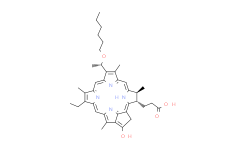
| 商品编号 | 规格 | 价格 | 会员价 | 是否有货 | 数量 |
|---|---|---|---|---|---|
| PL10916-5mg | 5mg | ¥1375.00 | 请登录 |
|
|
| PL10916-10mg | 10mg | ¥2225.00 | 请登录 |
|
|
| PL10916-25mg | 25mg | ¥3845.00 | 请登录 |
|
|
| PL10916-50mg | 50mg | ¥5455.00 | 请登录 |
|
|
| PL10916-100mg | 100mg | 询价 | 询价 |
|
|
| PL10916-10mM*1mLinDMSO | 10mM*1mLinDMSO | ¥4728.00 | 请登录 |
|
|
| PL10916-1 mL x 10 mM (in DMSO) | ¥1965.00 | 请登录 |
|

| 中文名称 |
HPPH
|
|---|---|
| 中文别名 |
光克洛;光克洛HPPH;焦脱镁叶绿酸a己醚
|
| 英文名称 |
HPPH
|
| 英文别名 |
3-Phorbinepropanoicacid, 14-ethyl-9-[1-(hexyloxy)ethyl]-4,8,13,18-tetramethyl-20-oxo-, (3S,4S)-;2-(1-hexyloxyethyl)-2-devinyl pyropheophorbide-a;3-{(3S,4S)-14-ethyl-9-[1-(hexyloxy)ethyl]-4,8,13,18-tetramethyl-20-oxo-24,25-dihydrophorbin-3-yl}propanoic acid;(3S,4S)-14-Ethyl-9-[1-(hexyloxy)ethyl]-4,8,13,18-tetramethyl-20-oxo-3-phorbinepropanoic acid;2-[1'-(Hexyloxy)ethyl]-2-devinylpyropheophorbide A;3-Devinyl-3-(1'-hexyloxy)ethylpyropheophorbide A;Photochlor;Sulcardine;Photochlor (HPPH);14-Ethyl-9-(1-(hexyloxy)ethyl)-4,8,13,18-tetramethyl-20-oxo-3-phorbine propanoic acid;3-Phorbinepropanoic acid, 14-ethyl-9-[1-(hexyloxy)ethyl]-4,8,13,18 -tetramethyl-20-oxo-, (3S,4S)-;CID 135565955;HPPH
|
| Cas No. |
149402-51-7
|
| 分子式 |
C39H48N4O4
|
| 分子量 |
636.82
|
| 包装储存 |
4°C, sealed storage, away from moisture and light In solvent : -80°C, 6 months; -20°C, 1 month (sealed storage, away from moisture and light)
|
| 详情描述 |
HPPH (Photochlor) 是第二代光敏剂,用于光动力疗法 (PDT)。
|
| 产品详情 |
HPPH (Photochlor) 是第二代光敏剂,用于光动力疗法 (PDT)。
|
|---|---|
| 生物活性 |
HPPH (Photochlor) is a second generation photosensitizer, which acts as a photodynamic therapy (PDT) agent.
|
| 性状 |
Solid
|
| 体外研究(In Vitro) |
Fluorescence image of 4T1 cells incubated with 0.49 μg/mL GO-PEG, 1 μM HPPH (free HPPH) or equivalent amount of GO-PEG-HPPH (1 μM HPPH and 0.49 μg/mL GO-PEG) after 24 h. The cellular uptake of GO-PEG-HPPH and HPPH is investigated with 4T1 murine mammary cancer cells. The cells are incubated with GO-PEG-HPPH and free HPPH at equivalent HPPH concentration (1 μM) for 24 h and then observed with a confocal microscope. Cells treated with GO-PEG-HHPH shows stronger fluorescence signal than those treated with free HPPH. In fact, the fluorescence of HPPH is rather weak. has not independently confirmed the accuracy of these methods. They are for reference only.
|
| 体内研究(In Vivo) |
Tumors are treated with an immune-enhancing PDT regimen followed by a tumor-controlling PDT regimen can leads to enhancement of anti-tumor immunity, while retaining effective control of primary tumor growth. To test this hypothesis, a combination treatment regimen is devised in which Colo26-HA tumor-bearing BALB/c mice are treated with a HPPH-PDT regimen known to lead to enhanced anti-tumor immunity (0.4 μmoles/kg HPPH followed 18 h later by illumination with 665 nm light for a total dose of 48 J/cm). Following illumination, mice are rested for 9 days; on the ninth day, mice are injected with HPPH. On day 10 following the first treatment, tumors are treated with a tumor control treatment regimen (illumination with 665 nm light for a total dose of 132 J/cm given). has not independently confirmed the accuracy of these met
|
| 运输条件 |
Room temperature in continental US; may vary elsewhere.
|
| 储存方式 |
4°C, sealed storage, away from moisture and light In solvent : -80°C, 6 months; -20°C, 1 month (sealed storage, away from moisture and light)
|
| ClinicalTrial |
|
| 参考文献 |
[1]. Rong P, et al. Photosensitizer loaded nano-graphene for multimodality imaging guided tumor photodynamic therapy. Theranostics. 2014 Jan 15;4(3):229-39.[2]. Shams M, et al. Development of photodynamic therapy regimens that control primary tumor growth and inhibit secondary disease. Cancer Immunol Immunother. 2015 Mar;64(3):287-97.
|
| 溶解度数据 |
In Vitro: DMSO : 125 mg/mL (196.29 mM; Need ultrasonic)配制储备液
|
|---|
1:一般建议:溶解度为Medlife测试数据,可能与文献描述存在差异。这是由于生产工艺和批次不同产生的正常现象。为了使其更好的溶解,请用37℃加热试管并在超声波水浴中震动片刻。不同批次产品溶解度各有差异,仅做参考,具体以实验方案为准。
2:储存条件:粉末-20°C一般情况可以保存3年,溶于溶剂-80°C一般情况可以保存1年。不同产品及不同批次产品可能存在差异,请细致阅读产品信息,并辅助参考相关文献描述。
Copyright © 2025 陌孚医药 All rights reserved 未经授权禁止拷贝本站所有资料,如有违反,将追究法律责任。
 沪ICP备2023012080号 |
  沪公网安备31011402010657号
 扫码关注公众号

 产品使用指南
