
购物车0
产品总数:61745


| 中文名称 |
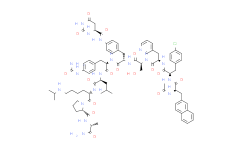
Degarelix
|
|---|---|
| 中文别名 |
醋酸地加瑞克;地加瑞克;加瑞克标准品
|
| 英文名称 |
Degarelix
|
| 英文别名 |
Degarelix acetate;N-Acetyl-3-(2-naphthyl)-D-alanyl-4-chloro-D-phenylalanyl-3-(3-pyridyl)-D-alanyl-L-seryl-4-[2,6-dioxohexahydropyrimidin-4(S)-ylcarboxamido]-L-phenylalanyl-4-ureido-D-phenylalanyl-L-leucyl-N6-isopropyl-L-lysyl-L-prolyl-D-alaninamide acetate;Degarelix;Ac-D-2Nal-D-4Cpa-D-3Pal-Ser-4Aph(L-hydroorotyl)-D-4Aph(carbamoyl)-Leu-ILys-Pro-D-Ala-NH2;acetyl-3-(naphthalen-2-yl)-D-alanyl-4-chloro-D-phenylalanyl-3-(pyridin-3-yl)-D-alanyl-Ser-4-((((4S)-2,6-dioxohexahydropyrimidin-4-yl)carbonyl)amino)-L-phenylalanyl-4-(carbamoylamino)-D-phenylalanyl-Leu-N6-(1-methylethyl)-L-lysyl-Pro-D-Ala-NH2;SX0XJI3A11;UNII-SX0XJI3A11;地加瑞克
|
| Cas No. |
214766-78-6
|
| 分子式 |
C82H103ClN18O16.C2H4O2
|
| 分子量 |
1692.33
|
| 包装储存 |
Sealed storage, away from moisturePowder -80°C 2 years;-20°C 1 year
|
| 详情描述 |
Degarelix 是一种竞争性的、可逆的促性腺激素释放激素受体 (GnRHR/LHRHR) 拮抗剂。Degarelix 可用于前列腺癌的研究。
|
| 产品详情 |
Degarelix 是一种竞争性的、可逆的促性腺激素释放激素受体 (GnRHR/LHRHR) 拮抗剂。Degarelix 可用于前列腺癌的研究。
|
|---|---|
| 生物活性 |
Degarelix is a competitive and reversible gonadotropin-releasing hormone receptor (GnRHR/LHRHR) antagonist. Degarelix can be used for prostate cancer research.
|
| 性状 |
Solid
|
| IC50 & Target[1][2] |
GnRHR
|
| 体外研究(In Vitro) |
Degarelix shows only very weak histamine-releasing properties and the lowest capacity for histamine release among the antagonists of LHRH, including Cetrorelix (HY-P0009), Abarelix (HY-13534), and Ganirelix (HY-P1628).Degarelix (1 nM-10 μM, 0-72 h) reduces cell viability in all prostate cell lines (WPE1-NA22, WPMY-1, BPH-1, VCaP cells), with the exception of the PC-3 cells.Degarelix (10 μM, 0-72 h) exerts a direct effect on prostate cell growth through apoptosis. has not independently confirmed the accuracy of these methods. They are for reference only.
|
| 体内研究(In Vivo) |
Degarelix (0-10 μg/kg; s.c.; once) decreases plasma LH levels and plasma testosterone levels in a dose-dependent manner in castrated rats.
Degarelix is stable when incubated in microsomes and cryopreserved hepatocytes from animal liver tissue. In rat and dog, most of the degarelix dose is eliminated within 48 h via urine and feces in equal amounts (40–50% in each matrix), whereas in monkey the major route of excretion is fecal (50%) and renal (22%). has not independently confirmed the accuracy of these methods. They are for reference only.
|
| 运输条件 |
Room temperature in continental US; may vary elsewhere.
|
| 储存方式 |
Sealed storage, away from moisturePowder -80°C 2 years;-20°C 1 year
|
| ClinicalTrial |
|
| 参考文献 |
[1]. Rick FG, et al. An update on the use of degarelix in the treatment of advanced hormone-dependent prostate cancer. Onco Targets Ther. 2013 Apr 16;6:391-402.[2]. Sakai M, et al. In search of the molecular mechanisms mediating the inhibitory effect of the GnRH antagonistdegarelix on human prostate cell growth. PLoS One. 2015 Mar 26;10(3):e0120670.
|
| 溶解度数据 |
In Vitro: DMSO : 10 mg/mL (6.13 mM; Need ultrasonic)H2O : 5 mg/mL (3.06 mM; ultrasonic and warming and heat to 60°C)配制储备液
|
|---|
1:一般建议:溶解度为Medlife测试数据,可能与文献描述存在差异。这是由于生产工艺和批次不同产生的正常现象。为了使其更好的溶解,请用37℃加热试管并在超声波水浴中震动片刻。不同批次产品溶解度各有差异,仅做参考,具体以实验方案为准。
2:储存条件:粉末-20°C一般情况可以保存3年,溶于溶剂-80°C一般情况可以保存1年。不同产品及不同批次产品可能存在差异,请细致阅读产品信息,并辅助参考相关文献描述。
Copyright © 2025 陌孚医药 All rights reserved 未经授权禁止拷贝本站所有资料,如有违反,将追究法律责任。
 沪ICP备2023012080号 |
  沪公网安备31011402010657号
 扫码关注公众号
 产品使用指南
