
购物车0
产品总数:56397
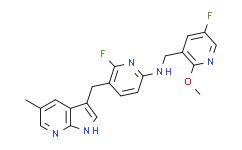

| 中文名称 |
PLX5622
|
|---|---|
| 英文名称 |
PLX5622
|
| 英文别名 |
PLX5622;6-Fluoro-N-((5-fluoro-2-methoxypyridin-3-yl)methyl)-5-((5-methyl-1H-pyrrolo[2,3-b]pyridin-3-yl)methyl)pyridin-2-amine;6-fluoro-N-[(5-fluoro-2-methoxypyridin-3-yl)methyl]-5-[(5-methyl-1H-pyrrolo[2,3-b]pyridin-3-yl)methyl]pyridin-2-amine;BDBM174948;s8874;ZB1607;CID 52936034
|
| Cas No. |
1303420-67-8
|
| 分子式 |
C21H19F2N5O
|
| 分子量 |
395.41
|
| 包装储存 |
Powder -20°C 3 years;4°C 2 years
|
| 详情描述 |
PLX5622 是高度选择性的、能透过血脑屏障的、口服有效的 CSF1R 抑制剂 (IC50= 0.016 µM; Ki= 5.9 nM),可用于病程发展前和过程中,扩大的和特异性的小胶质细胞的消除。PLX5622 具有较好的药理学特性。
|
| 产品详情 |
PLX5622 是高度选择性的、能透过血脑屏障的、口服有效的 CSF1R 抑制剂 (IC50= 0.016 µM; Ki= 5.9 nM),可用于病程发展前和过程中,扩大的和特异性的小胶质细胞的消除。PLX5622 具有较好的药理学特性。
|
|---|---|
| 生物活性 |
PLX5622 is a highly selective brain penetrant and orally active CSF1R inhibitor (IC 50 =0.016 μM; K i =5.9 nM). PLX5622 allows for extended and specific microglial cells elimination, preceding and during pathology development. PLX5622 demonstrates desirable PK properties in varies animals.
|
| 性状 |
Solid
|
| IC50 & Target[1][2] |
IC50: 0.016 μM (CSF1R); Ki: 5.9 nM (CSF1R)
|
| 体外研究(In Vitro) |
PLX5622 (1-20 μM; 3 days) effectively depletes microglia without affecting oligodendrocytes or astrocytes in cerebellar slices. PLX5622 (4 μM; 3 days) causes a 30-40% reduction in NG2+ or PDGFRα+ cells, and this increased to 90-95% at 20 μM. No reduction of NG2+ or PDGFRα+ OPCs is observed in slices exposed to 1 μM or 2 μM PLX5622 despite robust (~95%) depletion of the microglial cells. has not independently confirmed the accuracy of these methods. They are for reference only.
|
| 体内研究(In Vivo) |
Pharmacodynamics of PLX5622 in preclinical studies
PLX5622 (1200 ppm; chow; for 3 weeks or 3 days; adult C57/Bl6 wild type mice) leads to around 80% of microglia lost after 3 days of treatment and a 99% microglia loss after 3 weeks of treatment. PLX5622 (adult C57/Bl6 wild type mice aged 3 months; diet for 3 weeks) decreases microglia in cortex, striatum, cerebellum and hippocampus.
PLX5622 (50?mg/kg; intraperitoneal injection; once (neonatal rat) or twice (adult rat) a day; for a total of 14 days) depletes microglia by 80-90% within 3 days of treatment, which increases to > 90% by 7 days. After 14 days of PLX5622 treatment, microglia is depleted by > 96% in both neonates and adults while preserving baseline astrocyte quantity. (A single daily injection of 0.65% PLX5622 suspended in 5% dimethyl sulfoxide and 20% Kolliphor RH40 in 0.01?
|
| 运输条件 |
Room temperature in continental US; may vary elsewhere.
|
| 储存方式 |
Powder -20°C 3 years;4°C 2 years
|
| ClinicalTrial |
|
| 参考文献 |
[1]. Spangenberg E, et al. Sustained microglial depletion with CSF1R inhibitor impairs parenchymal plaque development in an Alzheimers disease model. Nat Commun. 2019 Aug 21;10(1):3758.[2]. Lee S, et al. Targeting macrophage and microglia activation with colony stimulating factor 1 receptor inhibitor is an effective strategy to treat injury-triggered neuropathic pain. Mol Pain. 2018 Jan-Dec;14:1744806918764979.
|
| 溶解度数据 |
In Vitro: DMSO : 25 mg/mL (63.23 mM; ultrasonic and warming and heat to 80°C)Ethanol : 3.33 mg/mL (8.42 mM; ultrasonic and warming and heat to 60°C)H2O : < 0.1 mg/mL (insoluble)
|
|---|
1:一般建议:溶解度为Medlife测试数据,可能与文献描述存在差异。这是由于生产工艺和批次不同产生的正常现象。为了使其更好的溶解,请用37℃加热试管并在超声波水浴中震动片刻。不同批次产品溶解度各有差异,仅做参考,具体以实验方案为准。
2:储存条件:粉末-20°C一般情况可以保存3年,溶于溶剂-80°C一般情况可以保存1年。不同产品及不同批次产品可能存在差异,请细致阅读产品信息,并辅助参考相关文献描述。
Copyright © 2025 陌孚医药 All rights reserved 未经授权禁止拷贝本站所有资料,如有违反,将追究法律责任。
 沪ICP备2023012080号 |
  沪公网安备31011402010657号
 扫码关注公众号

 产品使用指南
