
购物车0
产品总数:61745
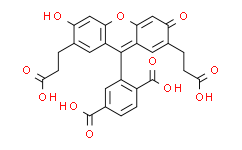


| 中文名称 |
2,7-双-(羧乙基)-羧基-荧光素
|
|---|---|
| 中文别名 |
2'',7''-二-(2-羧乙基)-5(6)-羧基荧光素;2 ,7 -二-(2-羧乙基)-5(6)-羧基荧光素;2',7'-二-(2-羧乙基)-5(6)-羧基荧光素;2,7-二-(2-羧乙基)-5(6)-羧基荧光素(混合物);2'',7''-双(2-羧基乙基)-5(6)-羧基荧光素;2,7-双(2-羧基乙基)-5(6)-羧基荧光素;2,7-双(2-羧乙基)-5(6)-羧基荧光素;2',7'-双(2-羧基乙基)-5(6)-羧基荧光素;2,7-双-(羧乙基)-羧基-荧光素;5(or 6)-羧基-3',6'-二羟基-3-氧代-螺[异苯并呋喃-1(3H),9'-[9H]氧杂蒽]-2',7'-二丙酸
|
| 英文名称 |
Spiro[isobenzofuran-1(3H),9'-[9H]xanthene]-2',7'-dipropanoicacid, 5(or 6)-carboxy-3',6'-dihydroxy-3-oxo-
|
| 英文别名 |
2′,7′-Bis(2-carboxyethyl)-5(6)-carboxyfluorescein;2',7'-Bis(2-carboxyethyl)-5(6)-carboxyfluorescein;2',7'-bis(Carboxyethyl)-5(6)-Carboxyfluorescein (BCECF);2-[2,7-bis(2-carboxyethyl)-3-hydroxy-6-oxoxanthen-9-yl]terephthalic acid;BCECF;Spiro[isobenzofuran-1(3H),9'-[9H]xanthene]-2',7'-dipropanoicacid, 5(or 6)-carboxy-3',6'-dihydr...;Spiro[isobenzofuran-1(3H),9'-[9H]xanthene]-2',7'-dipropanoicacid, 5(or 6)-carboxy-3',6'-dihydroxy-3-oxo-;BCECF acid
|
| Cas No. |
85138-49-4
|
| 分子式 |
C27O11H20
|
| 分子量 |
520.44
|
| 包装储存 |
-20°C, protect from light *In solvent : -80°C, 6 months; -20°C, 1 month (protect from light) |
| 详情描述 |
85138-49-4,2,7-双-(羧乙基)-羧基-荧光素,BCECF,Medlife,上海现货。
Medlife,致力于提供高品质、高性价比小分子化合物的产品。
Medlife小分子化合物大量库存,提供超过2万种的抑制剂、激动剂、拮抗剂等产品,是药物及疾病研究的重要原料供应商。
pH荧光探针,膜不通透,BCECF 是一种脱色染料, 激发波长为 420~520 nm, 发射波长为 530 nm.
查询关键词:<strong>“85138-49-4,2,7-双-(羧乙基)-羧基-荧光素,BCECF,</strong><strong>PC15604</strong><strong>,Medlife,上海现货”。</strong>
|
| 生物活性 |
BCECF is a pH-sensitive fluorescent dye. BCECF allows measurements in the physiological pH range 6.0–8.0. Excitation ratio: 490/440 nm; Emission intensity: 535 nm. |
|---|---|
| 性状 |
Solid |
| 体外研究(In Vitro) |
Guidelines (Following is our recommended protocol. This protocol only provides a guideline, and should be modified according to your specific needs). Medlife has not independently confirmed the accuracy of these methods. They are for reference only. |
| 运输条件 |
Room temperature or refrigerated transportation. |
| 储存方式 |
-20°C, protect from light *In solvent : -80°C, 6 months; -20°C, 1 month (protect from light) |
| 参考文献 |
| 溶解度数据 |
体外研究:
DMSO : 62.5 mg/mL (120.09 mM; Need ultrasonic) 配制储备溶液
*
产品不同,其溶解度不同。建议根据产品选择合适的溶剂配制储备溶液;配成溶液后,建议分装保存,避免反复冻融造成的产品失效。 体内研究:
建议根据您的实验动物和给药方式选择适当的溶解方案。以下溶解方案都建议先按照 体外研究 方式配制澄清的储备液,再依次添加助溶剂:
——为保证实验结果的可靠性,澄清的储备液可以根据储存条件,适当保存;体内实验的工作液,建议您现用现配,当天使用;
以下溶剂前显示的百
*
|
|---|
1:一般建议:溶解度为Medlife测试数据,可能与文献描述存在差异。这是由于生产工艺和批次不同产生的正常现象。为了使其更好的溶解,请用37℃加热试管并在超声波水浴中震动片刻。不同批次产品溶解度各有差异,仅做参考,具体以实验方案为准。
2:储存条件:粉末-20°C一般情况可以保存3年,溶于溶剂-80°C一般情况可以保存1年。不同产品及不同批次产品可能存在差异,请细致阅读产品信息,并辅助参考相关文献描述。
Copyright © 2025 陌孚医药 All rights reserved 未经授权禁止拷贝本站所有资料,如有违反,将追究法律责任。
 沪ICP备2023012080号 |
  沪公网安备31011402010657号
 扫码关注公众号
 产品使用指南
