
购物车0
产品总数:56378
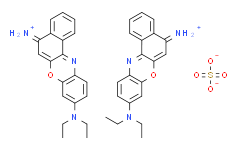


| 中文名称 |
Nile Blue A sulfate
|
|---|---|
| 中文别名 |
尼尔兰;耐尔兰;耐尔蓝A;耐尔兰指示液;硫酸耐尔蓝;硫酸尼罗蓝;尼罗蓝A;尼罗蓝 A;耐尔蓝 A
|
| 英文名称 |
Nile Blue A sulfate
|
| 英文别名 |
Nile blue;Nile Blue A;C.I. 51180;[9-(diethylamino)benzo[a]phenoxazin-5-ylidene]azanium,sulfate;Nile Blue Hydrogensulfate;5-amino-9-(diethylamino)-benzo(a)phenoxazin-7-iusulfate(2:1);9-(diethylamino)-5-imino-5h-;Basic Blue 12,Nile blue sulfate;Basic Blue-?12;CI 51180;EINECS 222-832-5;Nile Blue A sulfate;Nile Blue A, certified, pure;Nile Blue A, pure, certified;Nile Blue A,certified;Nile blue, sulfate;Basic Blue 12;Benzo[.alpha.] phenoxazin-7-ium, 5-amino-9-(diethylamino)-, sulfate;5-amino-9-(diethylamino)-benzo(a)phenoxazin-7-iu sulfate;Bis[5-amino-9-(diethylamino)benzo[a]phenoxazin-7-ium] sulphate;Nile blue sulfate;Benzo[a]phenoxazin-7-ium, 5-amino-9-(diethylamino)-, sulfate (2:1);5H-Benzo(a)phenazoxazine, 9-(diethylamino)-5-imino-, sulfate (2:1);Bis(5-amino-9-(diethylamino)benzo(a)phenoxazin-7-ium) sulphate;BENZO(a)PHENOXAZIN-7-IUM, 5-AMINO-9-(DIETHYLAMINO)-, SULFATE (2:1);2C20H20N3O
|
| Cas No. |
3625-57-8
|
| 分子式 |
C40H40N6O6S
|
| 分子量 |
732.85
|
| 包装储存 |
4°C, sealed storage, away from moisture and light In solvent : -80°C, 6 months; -20°C, 1 month (sealed storage, away from moisture and light)
|
| 详情描述 |
Nile Blue A (Nile blue sulfate) 可用于区分黑色素和脂褐素。它也可用于脂肪染色,以及制备电流葡萄糖传感器。
|
| 产品详情 |
Nile Blue A (Nile blue sulfate) 可用于区分黑色素和脂褐素。它也可用于脂肪染色,以及制备电流葡萄糖传感器。
|
|---|---|
| 生物活性 |
Nile Blue A (Nile blue sulfate) is used to differentiate melanins and lipofuscins. It is also useful for staining fats and preparation of an amperometric glucose sensor.
|
| 性状 |
Solid
|
| 体外研究(In Vitro) |
Nile blue A is a basic oxazine dye which is soluble in water and ethyl alcohol. Nile blue A is a satisfactory stain for PHB granules in bacteria and is in fact superior to Sudan black B for this purpose. Poly-p3-hydroxybutyrate granules exhibits a strong orange fluorescence when stained with Nile blue A. Nile blue A appears to stain many more PHB granules than Sudan black B does and is not as easily ished from the cell by decolorization procedures. Nile blue A is used as a stain for polyhydroxyalkanoic acid-accumulating microorganisms or to detect polyhydroxyalkanoic acids in microorganisms. Escherichia coli cells that do not accumulate detectable polyhydroxyalkanoic acids can be stained with Nile blue A and that this staining is sufficient for identifying these cells in fluorescence-activated cell sorting (FACS) experiments. Nile blue A staining does not affect either
|
| 运输条件 |
Room temperature in continental US; may vary elsewhere.
|
| 储存方式 |
4°C, sealed storage, away from moisture and light In solvent : -80°C, 6 months; -20°C, 1 month (sealed storage, away from moisture and light)
|
| 参考文献 |
[1]. Ostle AG, et al. Nile blue A as a fluorescent stain for poly-beta-hydroxybutyrate. Appl Environ Microbiol. 1982 Jul;44(1):238-41.[2]. Betscheider D, et al. Nile blue A for staining Escherichia coli in flow cytometer experiments. Anal Biochem. 2009 Jan 1;384(1):194-6.[3]. Mishra SS, et al. Spectroscopic invest
|
| 溶解度数据 |
In Vitro: DMSO : ≥ 150 mg/mL (409.37 mM)H2O : < 0.1 mg/mL (ultrasonic;warming) (insoluble)
|
|---|
1:一般建议:溶解度为Medlife测试数据,可能与文献描述存在差异。这是由于生产工艺和批次不同产生的正常现象。为了使其更好的溶解,请用37℃加热试管并在超声波水浴中震动片刻。不同批次产品溶解度各有差异,仅做参考,具体以实验方案为准。
2:储存条件:粉末-20°C一般情况可以保存3年,溶于溶剂-80°C一般情况可以保存1年。不同产品及不同批次产品可能存在差异,请细致阅读产品信息,并辅助参考相关文献描述。
Copyright © 2025 陌孚医药 All rights reserved 未经授权禁止拷贝本站所有资料,如有违反,将追究法律责任。
 沪ICP备2023012080号 |
  沪公网安备31011402010657号
 扫码关注公众号
 产品使用指南
