
购物车0
产品总数:56378
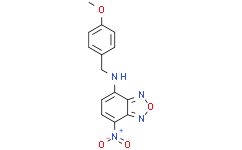


| 中文名称 |
MBD
|
|---|---|
| 中文别名 |
4-(4-甲氧基苯氨基)-7-硝基苯呋咱;4-(4-甲氧基苄氨基)-7-硝基苯并呋咱;4-(4-甲氧基苄氨基)-7-硝基苯呋咱(MBD);4-(对甲氧基苄氨基)-7-硝基-2,1,3-苯并噁二唑
|
| 英文名称 |
MBD
|
| 英文别名 |
1-Cyclohexen-1-ol,5-methyl-2-(1-methylethyl)-, 1-acetate, (5R)-;Mbd;N-[(4-methoxyphenyl)methyl]-4-nitro-2,1,3-benzoxadiazol-7-amine;4-(4-Methoxybenzylamino)-7-nitro-2,1,3-benzoxadiazole;4-(4-Methoxybenzylamino)-7-nitro-2,1,3-benzoxadiazole,MBD;4-(4-Methoxybenzylamino)-7-nitrobenzofurazan;4-(4-methoxybenzylamino)-7-nitrobenzofurazane;7-(p-Methoxybenzylamino)-4-nitrobenz-2-oxa-1,3-diazol;Benzofurazan,4-((p-methoxybenzyl)amino)-7-nitro;s-benzofurazanamine,N-[(4-methoxyphenyl)methyl]-7-nitro;t56 bnonj fnw im1r do1[wln];MBD
|
| Cas No. |
33984-50-8
|
| 分子式 |
C14H12N4O4
|
| 分子量 |
300.27
|
| 包装储存 |
4°C, protect from light In solvent : -80°C, 6 months; -20°C, 1 month (protect from light)
|
| 详情描述 |
MBD (7-(p-Methoxybenzylamino)-4-nitrobenz-2,1,3-oxadiazole),一种新的蛋白质和核蛋白构象荧光探针,可用于细菌核糖体、牛胰蛋白酶原和胰蛋白酶。MBD 在与大分子的疏水区域结合时具有强荧光性。
|
| 产品详情 |
MBD (7-(p-Methoxybenzylamino)-4-nitrobenz-2,1,3-oxadiazole),一种新的蛋白质和核蛋白构象荧光探针,可用于细菌核糖体、牛胰蛋白酶原和胰蛋白酶。MBD 在与大分子的疏水区域结合时具有强荧光性。
|
|---|---|
| 生物活性 |
MBD (7-(p-Methoxybenzylamino)-4-nitrobenz-2,1,3-oxadiazole), a new fluorescent probe for protein and nucleoprotein conformation, is applied to bacterial ribosomes and to bovine trypsinogen and trypsin. MBD is strongly fluorescent upon binding to a hydrophobic area of a macromolecule.
|
| 性状 |
Solid
|
| 运输条件 |
Room temperature in continental US; may vary elsewhere.
|
| 储存方式 |
4°C, protect from light In solvent : -80°C, 6 months; -20°C, 1 month (protect from light)
|
| 参考文献 |
[1]. Kenner RA, et al. A new fluorescent probe for protein and nucleoprotein conformation. Binding of 7-(p-methoxybenzylamino)-4-nitrobenzoxadiazole to bovine trypsinogen and bacterial ribosomes. Biochemistry. 1971;10(24):4433-4440.[2]. Kasahara Y, et al. Formation of a conformationally changed C1r, a subcomponent of the first component of human complement, as an intermediate of its autoactivation reaction. FEBS Lett. 1982;141(1):128-131.
|
| 溶解度数据 |
In Vitro: DMSO : 25 mg/mL (83.26 mM; ultrasonic and warming and heat to 60°C)配制储备液
|
|---|
1:一般建议:溶解度为Medlife测试数据,可能与文献描述存在差异。这是由于生产工艺和批次不同产生的正常现象。为了使其更好的溶解,请用37℃加热试管并在超声波水浴中震动片刻。不同批次产品溶解度各有差异,仅做参考,具体以实验方案为准。
2:储存条件:粉末-20°C一般情况可以保存3年,溶于溶剂-80°C一般情况可以保存1年。不同产品及不同批次产品可能存在差异,请细致阅读产品信息,并辅助参考相关文献描述。
Copyright © 2025 陌孚医药 All rights reserved 未经授权禁止拷贝本站所有资料,如有违反,将追究法律责任。
 沪ICP备2023012080号 |
  沪公网安备31011402010657号
 扫码关注公众号
 产品使用指南
