
购物车0
产品总数:56421

| 中文名称 |
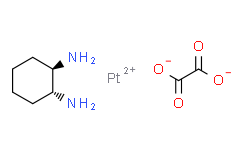
Oxaliplatin.
|
|---|---|
| 中文别名 |
奥沙利铂;左旋反式二氨环己烷草酸铂;己草铂;奥沙利铂(抗肿瘤医药中间体);(SP-4-2)-((1R,2R)-1,2-环己二胺-N,N')(乙二酸(2-)-O,O')铂;奥萨力铂;草酸铂;奥利沙铂;奥萨力铂,奥沙利铂;奥沙利铂对照;草酸铂 EP标准品;喷托维林;炔诺酮;(反-1,2-环己烷二胺)草酸铂(II);奥沙利铂对照品
|
| 英文名称 |
Eloxatin (TN)
|
| 英文别名 |
Oxaliplatin;L-OHP;[SP-4-2-(1R-TRANS)]-(1,2-CYCLOHEXANEDIAMINE-N,N')[ETHANEDIOATA(2-)-O,O']PLATINUM;trans-l-diaminocyclohexane oxalatoplatinum;(1,2-cyclohexanediamine-n,n’)(ethanedioato(2-)-o,o’)-platinu(sp-4-2-(1r-tr;1-ohp;oxalato(1r,2r-cyclohexanediammine)platinum(ii);oxalatoplatin;oxalatoplatinum;Oxaliplatin DMF;Dacplat;Elocatin;[SP-4-2-(1R-trans)]-(1,2-Cyclohexanediamine-N,N′)[ethanedioata(2--)-O,O’]platinum;(trans-1,2-Cyclohexanediamine)oxalatoplatinum(II);Eloxatin (TN);Oxaliplatin (JAN/USAN/INN);Oxaliplatin (Eloxatin);s1224;SW219151-1;O0372;D01790;AB01568250_01;15171-
|
| Cas No. |
61825-94-3
|
| 分子式 |
C8H14N2O4Pt
|
| 分子量 |
397.29
|
| 包装储存 |
4°C, protect from light *In solvent : -80°C, 6 months; -20°C, 1 month (protect from light) |
| 详情描述 |
Oxaliplatin是一种DNA合成抑制剂。它会导致DNA交联损伤,阻止DNA复制和转录并导致细胞死亡。 |
| 生物活性 |
Oxaliplatin is a DNA synthesis inhibitor. Oxaliplatin causes DNA crosslinking damage, prevents DNA replication and transcription and induces apoptosis. Oxaliplatin can be used for cancer research. |
||||||||||||||||||||||||
|---|---|---|---|---|---|---|---|---|---|---|---|---|---|---|---|---|---|---|---|---|---|---|---|---|---|
| 性状 |
Solid |
||||||||||||||||||||||||
| IC50 & Target[1][2] |
IC50: DNA synthesis |
||||||||||||||||||||||||
| 体外研究(In Vitro) |
Oxaliplatin (24-72 hours; 2-128 μM; HCC, HCCLM3 and Hep3B cells) inhibits cell growth and induces apoptosis. Medlife has not independently confirmed the accuracy of these methods. They are for reference only. Cell Viability Assay
Cell Cycle Analysis
Cell Cycle Analysis
|
||||||||||||||||||||||||
| 体内研究(In Vivo) |
Oxaliplatin (5-10 mg/kg; i.p.; for 32 days; nude mice) inhibits tumor growth. Medlife has not independently confirmed the accuracy of these methods. They are for reference only.
|
||||||||||||||||||||||||
| 运输条件 |
Room temperature or refrigerated transportation. |
||||||||||||||||||||||||
| 储存方式 |
4°C, protect from light *In solvent : -80°C, 6 months; -20°C, 1 month (protect from light) |
||||||||||||||||||||||||
| ClinicalTrial |
|
||||||||||||||||||||||||
| 参考文献 |
|
| 溶解度数据 |
体外研究:
H2O : 2.17 mg/mL (5.46 mM; ultrasonic and warming and heat to 60°C; DMSO can inactivate Oxaliplatins activity) DMF : 1.67 mg/mL (4.20 mM; Need ultrasonic; DMSO can inactivate Oxaliplatins activity) Ethanol : < 1 mg/mL (insoluble; DMSO can inactivate Oxaliplatins activity) 配制储备溶液
*
产品不同,其溶解度不同。建议根据产品选择合适的溶剂配制储备溶液;配成溶液后,建议分装保存,避免反复冻融造成的产品失效。 体内研究:
建议根据您的实验动物和给药方式选择适当的溶解方案。以下溶解方案都建议先按照 体外研究 方式配制澄清的储备液,再依次添加助溶剂:
——为保证实验结果的可靠性,澄清的储备液可以根据储存条件,适当保存;体内实验的工作液,建议您现用现配,当天使用;
以下溶剂前显示的百
*
|
|---|
[1]. Raymond E, et al. Oxaliplatin: a review of preclinical and clinical studies. Ann Oncol. 1998 Oct;9(10):1053-71. [Information]
[2]. Mohammed MQ, et al. Oxaliplatin is active 体外研究 against human melanoma cell lines: comparison with NSC 119875 and NSC 241240. Anticancer Drugs. 2000 Nov;11(10):859-63. [Information]
[3]. Pendyala L, et al. 体外研究 cytotoxicity, protein binding, red blood cell partitioning, and biotransformation of oxaliplatin. Cancer Res. 1993 Dec 15;53(24):5970-6. [Information]
[4]. Wang Z, et al. Oxaliplatin induces apoptosis in hepatocellular carcinoma cells and inhibits tumor growth. Expert Opin Investig Drugs. 2009 Nov;18(11):1595-604 [Information]
[5]. Mathé G, et al. Oxalato-platinum or 1-OHP, a third-generation platinum complex: an experimental and clinical appraisal and preliminary comparison with cis-platinum. Biomed Pharmacother. 1989;43(4):237-50. [Information]
[6]. Schellingerhout D, et al. Impairment of retrograde neuronal transport in oxaliplatin-induced neuropathy demonstrated by molecular imaging. PLoS One. 2012;7(9):e45776. doi: 10.1371/journal.pone.0045776. Epub 2012 Sep 20. [Information]
[7]. Park GY, et al. Phenanthriplatin, a monofunctional DNA-binding platinum anticancer drug candidate with unusual potency and cellular activity profile. Proc Natl Acad Sci U S A. 2012 Jul 24;109(30):11987-92. [Information]
[8]. Yi Yao, et al. Comparative proteomic analysis of colon cancer cells in response to oxaliplatin treatment. Biochim Biophys Acta. 2009 Oct;1794(10):1433-40. [Information]
[9]. Garrett MJ, et, al. Capecitabine, Oxaliplatin, and Bevacizumab (BCapOx) Regimen for Metastatic Colorectal Cancer. Hosp Pharm. 2017 May;52(5):341-347. [Information]
1:一般建议:溶解度为Medlife测试数据,可能与文献描述存在差异。这是由于生产工艺和批次不同产生的正常现象。为了使其更好的溶解,请用37℃加热试管并在超声波水浴中震动片刻。不同批次产品溶解度各有差异,仅做参考,具体以实验方案为准。
2:储存条件:粉末-20°C一般情况可以保存3年,溶于溶剂-80°C一般情况可以保存1年。不同产品及不同批次产品可能存在差异,请细致阅读产品信息,并辅助参考相关文献描述。
Copyright © 2025 陌孚医药 All rights reserved 未经授权禁止拷贝本站所有资料,如有违反,将追究法律责任。
 沪ICP备2023012080号 |
  沪公网安备31011402010657号
 扫码关注公众号

 产品使用指南
