
购物车0
产品总数:61739
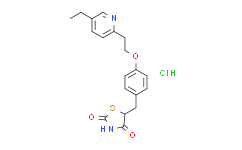


| 中文名称 |
Pioglitazone HCl.
|
|---|---|
| 中文别名 |
吡格列酮;5-{4-[2-(5-乙基-2-吡啶)-乙氧基]-苯基}-2,4-噻唑烷二酮盐酸盐;盐酸吡格列酮;皮格列酮;匹格列酮盐酸盐;盐酸皮格列酮;盐酸匹格列酮;盐酸吡咯列酮;安可妥;吡格列酮 GMP;Pioglitazone HCl 标准品;吡格列酮苯酸酯杂质;吡格列酮标准品(JP);吡格列酮系统适应性 EP标准品;吡格列酮盐酸盐;低分子右旋糖酐;夫西地酸;硒化卡拉胶;盐酸比格列酮;盐酸吡格列酮 EP标准品;盐酸吡格列酮 USP标准品;盐酸吡格列酮 标准品;盐酸吡格列酮中间体;比格列酮;盐酸吡格列酮;吡格列酮烯
|
| 英文名称 |
Pioglitazone HCl
|
| 英文别名 |
Pioglitazone Hydrochloride;Pioglitazone HCl;Pioglitazone N-Oxide;[5-[[4-[2-(5-Ethyl-2-pyridinyl)ethoxy]phenyl]methyl]-2,4-] thiazolidinedione hydrochloride;5-(4-(2-(5-Ethylpyridin-2-yl)ethoxy)benzyl)thiazolidine-2,4-dione hydrochloride;Pioglitazone Hydroch;5-[[4-[2-(5-Ethyl-2-pyridinyl)ethoxy]phenyl]methyl]-2,4-thiazolidinedione monohydrochloride;5-[4-[2-(5-Ethyl-2-pyridyl)ethoxy]benzyl]-2,4-thiazolidinedione Hydrochloride;ACTOS;AD 4833;AD-4833;Effects of pioglitazone;Pioditazone hydrochloride;PIODLITAZONE HYDROCHLORIC;pioglitazone hydrochioride;U 72107A;5-[4-[2-(5-Ethyl-2-pyridinyl)ethoxy]benzyl]thiazolidine-2,4-dione hydrochloride;U-72107E;U-72107A;Pioglitazone (hydrochloride);Actos (TN);DSSTox_RID_80116;DSSTox_CID_24203;(+-)-5-(p-(2-(5-Ethyl-2-pyridyl)ethoxy)benzyl)-2,4-thiazolidinedione monohydrochloride;DSSTox_GSID_44203;C19H21ClN2O3S;Glustin;DSSTox_GS
|
| Cas No. |
112529-15-4
|
| 分子式 |
C19H21ClN2O3S
|
| 分子量 |
392.90
|
| 包装储存 |
Sealed and stored at 4℃,, away from moisture *In solvent : -80°C, 6 months; -20°C, 1 month (sealed storage, away from moisture) |
| 详情描述 |
PPARγ激动剂,Pioglitazone 是一种有效,选择性的 PPARγ 激动剂,高亲和力结合到 PPARγ 配体结合域。作用于人和鼠 PPARγ,EC50 分别为 0.93 和 0.99 μM。 |
| 生物活性 |
Pioglitazone hydrochloride is a potent and selective PPARγ agonist with EC50s of 0.93 and 0.99 μM for human and mouse PPARγ, respectively. |
|||
|---|---|---|---|---|
| 性状 |
Solid |
|||
| IC50 & Target[1][2] |
|
|||
| 体外研究(In Vitro) |
AGEs-induced beta cell necrosis is completely abrogated by adding Pioglitazone to the AGEs culture medium. Furthermore Pioglitazone completely prevented any AGEs-induced increment in caspase-3 activation, thereby restoring caspase-3 activity to the same levels as the control cells. As expected AG is able to counteract AGEs-induced impaired viability. Medlife has not independently confirmed the accuracy of these methods. They are for reference only. |
|||
| 体内研究(In Vivo) |
The serum-free fatty acid and triglyceride levels as well as adipocyte sizes in ob/ob and adipo ob/ob mice are unchanged after 10 mg/kg Pioglitazone but are significantly reduced to a similar degree after 30 mg/kg Pioglitazone. Moreover, the expressions of TNFα and resistin in adipose tissues of ob/ob and adipo ob/ob mice are unchanged after 10 mg/kg Pioglitazone but are decreased after 30 mg/kg Pioglitazone. Thus, Pioglitazone-induced amelioration of insulin resistance and diabetes may occur adiponectin dependently in the liver and adiponectin independently in skeletal muscle. Pioglitazone (10 mg/kg per d) treatment significantly attenuates the loss of body weight (BW) and cardiac hypertrophy. Pioglitazone treatment significantly reduces the elevated serum glucose levels and markedly improved the associated dyslipidemia. Furthermore, there is a slight but significant increase in serum creatinine level in D rats over their N controls (P <0.05). However, a marked renal dysfunction is observed in diabetic nephropathic (DN) group (P<0.05). Moreover, DN rats exhibits the highest serum activity of CK-MB, relative to both N and D rats (P<0.05). Pioglitazone is able to decrease the elevated serum levels of both creatinine and creatine kinase-MB (CK-MB). Medlife has not independently confirmed the accuracy of these methods. They are for reference only. |
|||
| 运输条件 |
Room temperature or refrigerated transportation. |
|||
| 储存方式 |
Sealed and stored at 4℃,, away from moisture *In solvent : -80°C, 6 months; -20°C, 1 month (sealed storage, away from moisture) |
|||
| ClinicalTrial |
|
|||
| 参考文献 |
|
| 溶解度数据 |
体外研究:
DMSO : 100 mg/mL (254.52 mM; Need ultrasonic) H2O : < 0.1 mg/mL (ultrasonic;warming;heat to 60°C) (insoluble) 配制储备溶液
*
产品不同,其溶解度不同。建议根据产品选择合适的溶剂配制储备溶液;配成溶液后,建议分装保存,避免反复冻融造成的产品失效。 体内研究:
建议根据您的实验动物和给药方式选择适当的溶解方案。以下溶解方案都建议先按照 体外研究 方式配制澄清的储备液,再依次添加助溶剂:
——为保证实验结果的可靠性,澄清的储备液可以根据储存条件,适当保存;体内实验的工作液,建议您现用现配,当天使用;
以下溶剂前显示的百
*
|
|---|
[1]. Kuwabara K, et al. A novel selective peroxisome proliferator-activated receptor alpha agonist, 2-methyl-c-5-[4-[5-methyl-2-(4-methylphenyl)-4-oxazolyl]butyl]-1,3-dioxane-r-2-carboxylic acid (NS-220), potently decreases plasma triglyceride and glucose leve [Information]
[2]. Puddu A, et al. Pioglitazone attenuates the detrimental effects of advanced glycation end-products in the pancreatic beta cell line HIT-T15. Regul Pept. 2012 Aug 20;177(1-3):79-84. [Information]
[3]. Kubota N, et al. Pioglitazone ameliorates insulin resistance and diabetes by both adiponectin-dependent and -independent pathways. J Biol Chem. 2006 Mar 31;281(13):8748-55. [Information]
[4]. Elrashidy RA, et al. Pioglitazone attenuates cardiac fibrosis and hypertrophy in a rat model of diabetic nephropathy. J Cardiovasc Pharmacol Ther. 2012 Sep;17(3):324-33. [Information]
1:一般建议:溶解度为Medlife测试数据,可能与文献描述存在差异。这是由于生产工艺和批次不同产生的正常现象。为了使其更好的溶解,请用37℃加热试管并在超声波水浴中震动片刻。不同批次产品溶解度各有差异,仅做参考,具体以实验方案为准。
2:储存条件:粉末-20°C一般情况可以保存3年,溶于溶剂-80°C一般情况可以保存1年。不同产品及不同批次产品可能存在差异,请细致阅读产品信息,并辅助参考相关文献描述。
Copyright © 2025 陌孚医药 All rights reserved 未经授权禁止拷贝本站所有资料,如有违反,将追究法律责任。
 沪ICP备2023012080号 |
  沪公网安备31011402010657号
 扫码关注公众号
 产品使用指南
