
购物车0
产品总数:56421

| 中文名称 |
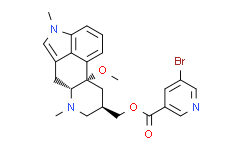
Nicergoline
|
||||||||||||
|---|---|---|---|---|---|---|---|---|---|---|---|---|---|
| 中文别名 |
麦角溴烟酯;尼麦角林;10-甲氧基-1,6-二甲基麦角林-8-甲醇 5-溴烟酸酯;脑通;你先获宁;麥角溴菸鹼酯;麦角灵;Nicergoline 尼麦角林;麦角溴烟酯 EP标准品;麦角溴烟酯用于峰鉴定 EP标准品;麦角溴烟酯用于系统适应性 EP标准品;尼麦角林 标准品;哌库溴铵;盐酸洛哌丁胺;[(8R,10S)-10-甲氧基-1,6-地甲基麦角林-8-基]甲基-5-溴吡啶-3-羧酸酯;5-溴吡啶-3-羧酸-[(8R,10S)-10-甲氧基-1,6-二甲基麦角林-8-基]甲酯;麦角溴烟酯 麦角溴烟酯
|
||||||||||||
| 英文名称 |
Nicergoline
|
||||||||||||
| 英文别名 |
nicergoline;-(+)-10-methoxy-1,6-dimethylergoline-8-beta-methanol5-bromonicotinate;10-methoxy-1,6-dimethyl-ergolin-8-beta-methanol-(5-bromnicotinat);10-methoxy-1,6-dimethyl-ergoline-8-beta-methano5-bromo-3-pyridinecarboxy;10-methoxy-1,6-dimethyl-ergoline-8-beta-methano5-bromonicotinate(ester);1-methyl-lumilysergol8-(5-bromonicotinate)10-methylether;8-beta-((5-bromonicotinoyloxy)methyl)-1,6-dimethyl-10-alpha-methoxyergoline;fi6714;[(8R,10S)-10-Methoxy-1,6-dimethylergolin-8-yl]methyl 5-Bromopyridine-3-carboxylate;5-bromo-nicotinic acid 10-methoxy-1,6-dimethyl-ergolin-8-ylmethyl ester;5-Bromopyridine-3-carboxylic Acid [(8R,10S)-10-Methoxy-1,6-dimethylergolin-8-yl]methyl Ester;Cergodum;Dilasenil;Ergobel;ergoline-8-methanol 10-methoxy-1,6-dimethyl-,8-(5-bromo-3-pyridinecarboxylate);Ergotop;Memoq;mne;nargoline;nigergoline;Sermion;TA 079;5-Bromonicotinic acid 10-methoxy-1,6-dimethylergoline-8-methyl ester;Nimergoline;Nimergoline base;Nicotergoline;Nicergolinum;Nicergolin [German];Nicergolina [DCIT];Nicergolinum [INN-Latin];C24H26BrN3O3;FI 6714;RP 19651;Sermion (TN);10-Methoxy-1,6-dimethylergoline-8beta-methanol 5-bromonicotinate;JCV8365FWN;10-Methoxy-1,6-dimethylergoline-8beta-methanol 5-bromonicotinate (ester)
|
||||||||||||
| Cas No. |
27848-84-6
|
||||||||||||
| 分子式 |
C24H26BrN3O3
|
||||||||||||
| 分子量 |
484.39
|
||||||||||||
| 包装储存 |
|
||||||||||||
| 详情描述 |
血管扩张剂,Nicergoline能抑制Alpha-1A肾上腺素受体。
|
| 生物活性 |
Nicergoline, an ergoline derivative ester of bromonicotinic acid, is a potent, selective and orally active antagonist of α1A-adrenoceptor. Nicergoline has vasodilator effects. Nicergoline also has ameliorative effects on cognitive function in mouse models of Alzheimers disease. |
||||||||||||
|---|---|---|---|---|---|---|---|---|---|---|---|---|---|
| 性状 |
Solid |
||||||||||||
| IC50 & Target[1][2] |
α1A-adrenoceptor |
||||||||||||
| 体外研究(In Vitro) |
Nicergoline (0.3-30 μM; 24 h) attenuates activated microglia- and astrocytes-induced neuronal cell death. Medlife has not independently confirmed the accuracy of these methods. They are for reference only. |
||||||||||||
| 体内研究(In Vivo) |
Nicergoline (10 mg/kg; i.v. once daily for 60 d) improves impaired neurogenesis and cognitive competence in mice with Alzheimers disease. Medlife has not independently confirmed the accuracy of these methods. They are for reference only.
|
||||||||||||
| 运输条件 |
Room temperature or refrigerated transportation. |
||||||||||||
| 储存方式 |
|
||||||||||||
| ClinicalTrial |
|
||||||||||||
| 参考文献 |
|
| 溶解度数据 |
体外研究:
DMSO : 100 mg/mL (206.45 mM; Need ultrasonic) 配制储备溶液
*
产品不同,其溶解度不同。建议根据产品选择合适的溶剂配制储备溶液;配成溶液后,建议分装保存,避免反复冻融造成的产品失效。 体内研究:
建议根据您的实验动物和给药方式选择适当的溶解方案。以下溶解方案都建议先按照 体外研究 方式配制澄清的储备液,再依次添加助溶剂:
——为保证实验结果的可靠性,澄清的储备液可以根据储存条件,适当保存;体内实验的工作液,建议您现用现配,当天使用;
以下溶剂前显示的百
*
|
|---|
[1]. Alvarez-Guerra, M., N. Bertholom, and R.P. Garay, Selective blockade by nicergoline of vascular responses elicited by stimulation of alpha 1A-adrenoceptor subtype in the rat. Fundam Clin Pharmacol, 1999. 13(1): p. 50-8. [Information]
[2]. Zang G, et, al. Ameliorative effect of nicergoline on cognitive function through the PI3K/AKT signaling pathway in mouse models of Alzheimers disease. Mol Med Rep. 2018 May;17(5):7293-7300. [Information]
[3]. Mizuno T, et, al. Protective effects of nicergoline against neuronal cell death induced by activated microglia and astrocytes. Brain Res. 2005 Dec 20;1066(1-2):78-85. [Information]
1:一般建议:溶解度为Medlife测试数据,可能与文献描述存在差异。这是由于生产工艺和批次不同产生的正常现象。为了使其更好的溶解,请用37℃加热试管并在超声波水浴中震动片刻。不同批次产品溶解度各有差异,仅做参考,具体以实验方案为准。
2:储存条件:粉末-20°C一般情况可以保存3年,溶于溶剂-80°C一般情况可以保存1年。不同产品及不同批次产品可能存在差异,请细致阅读产品信息,并辅助参考相关文献描述。
Copyright © 2025 陌孚医药 All rights reserved 未经授权禁止拷贝本站所有资料,如有违反,将追究法律责任。
 沪ICP备2023012080号 |
  沪公网安备31011402010657号
 扫码关注公众号

 产品使用指南
