
购物车0
产品总数:56379
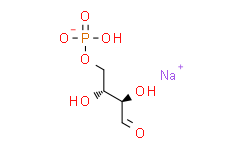


| 中文名称 |
D-Erythrose 4-phosphate sodium
|
|---|---|
| 中文别名 |
D-赤藓糖-4-磷酸钠;N-[6-(2,5-二氢-2,5-二氧代-1H-吡咯-1-基)-1-氧代己基]-L-缬氨酰-N5-(氨基甲酰基)-N-[4-(羟甲基)苯基]-L-鸟氨酰胺;D-赤藓糖-4-磷酸钠,D-Erythrose 4-phosphate sodium salt
|
| 英文名称 |
D-Erythrose 4-phosphate sodium
|
| 英文别名 |
D-ERYTHROSE 4-PHOSPHATE SODIUM SALT;Butanal, 2,3-dihydroxy-4-(phosphonooxy)-, monosodium salt, (2R,3R)-;D-Erythrose 4-phosphate sodium salt,4-Phospho-D-erythrose sodium salt;Butanal,2,3-dihydroxy-4-(phosphonooxy)-, monosodium salt, (2R,3R)- (9CI);sodium,[(2R,3R)-2,3-dihydroxy-4-oxobutyl] hydrogen phosphate;4-Phospho-D-erythrose sodium salt;E4P sodium salt;sodium D-erythrose 4-phosphate;D-ERYTHROSE 4-PHOSPHATE SODIUM;D-Erythrose 4-phosphate sodium
|
| Cas No. |
103302-15-4
|
| 分子式 |
C4H8O7P-.Na+
|
| 分子量 |
222.07
|
| 包装储存 |
-20°C, stored under nitrogen, away from moistur In solvent : -80°C, 6 months; -20°C, 1 month (stored under nitrogen, away from moisture)
|
| 详情描述 |
D-Erythrose 4-phosphate sodium 是单糖 Erythrose 的磷酸钠盐。Erythritol 转化为 D-Erythrose 4-phosphate 涉及三种异构酶。
|
| 产品详情 |
D-Erythrose 4-phosphate sodium 是单糖 Erythrose 的磷酸钠盐。Erythritol 转化为 D-Erythrose 4-phosphate 涉及三种异构酶。
|
|---|---|
| 生物活性 |
D-Erythrose 4-phosphate sodium is a phosphate sodium of the simple sugar Erythrose. Erythritol is actually converted into D-Erythrose 4-phosphate that involves three isomerases.
|
| 性状 |
Oil
|
| IC50 & Target[1][2] |
Human Endogenous Metabolite
|
| 体外研究(In Vitro) |
Erythritol is a preferential substrate for Brucella . Erythritol is actually converted into D-erythrose-4-phosphate through a set of reactions that involves three isomerases and that allows hexose-monophosphate synthesis and growth by feeding the pentose phosphate shunt. has not independently confirmed the accuracy of these methods. They are for reference only.
|
| 运输条件 |
Room temperature in continental US; may vary elsewhere.
|
| 储存方式 |
-20°C, stored under nitrogen, away from moistur In solvent : -80°C, 6 months; -20°C, 1 month (stored under nitrogen, away from moisture)
|
| 参考文献 |
[1]. Barbier T, et al. Erythritol feeds the pentose phosphate pathway via three new isomerases leading to D-erythrose-4-phosphate in Brucella. Proc Natl Acad Sci U S A. 2014 Dec 16;111(50):17815-20.
|
| 溶解度数据 |
In Vitro: H2O : 50 mg/mL (225.15 mM; Need ultrasonic and warming)配制储备液
|
|---|
1:一般建议:溶解度为Medlife测试数据,可能与文献描述存在差异。这是由于生产工艺和批次不同产生的正常现象。为了使其更好的溶解,请用37℃加热试管并在超声波水浴中震动片刻。不同批次产品溶解度各有差异,仅做参考,具体以实验方案为准。
2:储存条件:粉末-20°C一般情况可以保存3年,溶于溶剂-80°C一般情况可以保存1年。不同产品及不同批次产品可能存在差异,请细致阅读产品信息,并辅助参考相关文献描述。
Copyright © 2025 陌孚医药 All rights reserved 未经授权禁止拷贝本站所有资料,如有违反,将追究法律责任。
 沪ICP备2023012080号 |
  沪公网安备31011402010657号
 扫码关注公众号
 产品使用指南
