
购物车0
产品总数:56377
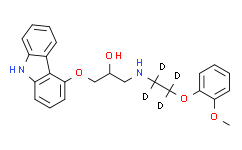


| 中文名称 |
Carvedilol-d4
|
|---|---|
| 中文别名 |
(±)-卡维地洛-d4(乙基-d4);1,2,3,4,5,6,7,8-八氢蒽;卡维地洛-D4(乙基-D4);卡维地洛-D4氘代
|
| 英文名称 |
Carvedilol-d4
|
| 英文别名 |
Carvedilol-d4 (ethyl-d4);1-(9H-carbazol-4-yloxy)-3-[[1,1,2,2-tetradeuterio-2-(2-methoxyphenoxy)ethyl]amino]propan-2-ol;Carvedilol-d4 (ethyl-d4)neat
|
| Cas No. |
1133705-56-2
|
| 分子式 |
C24H26N2O4
|
| 分子量 |
406.47
|
| 包装储存 |
Powder -20°C 3 years;4°C 2 years
|
| 详情描述 |
Carvedilol-d4 是 Carvedilol 的氘代物。Carvedilol (BM 14190) 是一种非选择性 β/α-1 受体阻断剂。Carvedilol 抑制脂质过氧化,IC50 为 5 μM。Carvedilol 是一种多用途降压剂,有潜力用于心绞痛和充血性心力衰竭的研究。Carvedilol是一种自噬 (autophagy) 诱导剂,可抑制 NLRP3 炎性体。
|
| 产品详情 |
Carvedilol-d4 是 Carvedilol 的氘代物。Carvedilol (BM 14190) 是一种非选择性 β/α-1 受体阻断剂。Carvedilol 抑制脂质过氧化,IC50 为 5 μM。Carvedilol 是一种多用途降压剂,有潜力用于心绞痛和充血性心力衰竭的研究。Carvedilol是一种自噬 (autophagy) 诱导剂,可抑制 NLRP3 炎性体。
|
|---|---|
| 生物活性 |
Carvedilol-d 4 is the deuterium labeled Carvedilol. Carvedilol (BM 14190) is a non-selective β/α-1 blocker[1]. Carvedilol inhibits lipid peroxidation in a dose-dependent manner with an IC50 of 5 μM. Carvedilol is a multiple action antihypertensive agent with potential use in angina and congestive heart failure[2]. Carvedilol is an autophagy inducer that inhibits the NLRP3 inflammasome[3].
|
| 性状 |
Solid
|
| 体外研究(In Vitro) |
Stable heavy isotopes of hydrogen, carbon, and other elements have been incorporated into drug molecules, largely as tracers for quantitation during the drug development process. Deuteration has gained attention because of its potential to affect the pharmacokinetic and metabolic profiles of drugs. has not independently confirmed the accuracy of these methods. They are for reference only.
|
| 运输条件 |
Room temperature in continental US; may vary elsewhere.
|
| 储存方式 |
Powder -20°C 3 years;4°C 2 years
|
| 参考文献 |
[1]. Russak EM, et al. Impact of Deuterium Substitution on the Pharmacokinetics of Pharmaceuticals. Ann Pharmacother. 2019;53(2):211-216. [2]. Eggertsen R, et al. Acute haemodynamic effects of carvedilol (BM 14190), a new combined beta-adrenoceptor blocker and precapillary vasodilating agent, in hypertensive patients. Eur J Clin Pharmacol. 1984;27(1):19-22.
|
1:一般建议:溶解度为Medlife测试数据,可能与文献描述存在差异。这是由于生产工艺和批次不同产生的正常现象。为了使其更好的溶解,请用37℃加热试管并在超声波水浴中震动片刻。不同批次产品溶解度各有差异,仅做参考,具体以实验方案为准。
2:储存条件:粉末-20°C一般情况可以保存3年,溶于溶剂-80°C一般情况可以保存1年。不同产品及不同批次产品可能存在差异,请细致阅读产品信息,并辅助参考相关文献描述。
Copyright © 2025 陌孚医药 All rights reserved 未经授权禁止拷贝本站所有资料,如有违反,将追究法律责任。
 沪ICP备2023012080号 |
  沪公网安备31011402010657号
 扫码关注公众号
 产品使用指南
