
购物车0
产品总数:56418

| 中文名称 |
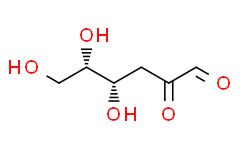
3-Deoxyglucosone
|
|---|---|
| 中文别名 |
3-脱氧葡萄糖醛;3-脱氧葡糖醛酮;3-葡萄糖醛酮;3-脱氧-D-葡糖醛酮;3-脱氧-D-葡糖酮醛
|
| 英文名称 |
3-Deoxyglucosone
|
| 英文别名 |
D-erythro-Hexos-2-ulose,3-deoxy-;3-Deoxy-D-erythro-hexosulose;3-deoxy Glucosone;3-DEOXYGLUCOSONE,AMORPHOUS YELLOW SOLID;(4S,5R)-2-Oxo-4,5,6-trihydroxyhexan-1-one;(4S,5R)-4,5,6-trihydroxy-2-oxohexanal;3-Deoxyglucosone
|
| Cas No. |
4084-27-9
|
| 分子式 |
C6H10O5
|
| 分子量 |
162.14
|
| 包装储存 |
Please store the product under the recommended conditions in the Certificate of Analysis.;
|
| 详情描述 |
3-Deoxyglucosone (3-Deoxy-D-glucosone) 是美拉德反应和多元醇途径的反应中间体 (intermediate)。3-Deoxyglucosone 与蛋白质氨基快速反应形成晚期糖基化终产物 (AGEs),例如咪唑啉酮,它是 3-DG 的最特异 AGE。3-Deoxyglucosone 可以与低葡萄糖协同作用以增强 GLP-1 分泌,可以作为糖尿病生物学检测的标志物。3-Deoxyglucosone (3-Deoxy-D-glucosone) 是美拉德反应和多元醇途径的反应中间体 (intermediate)。3-Deoxyglucosone 与蛋白质氨基快速反应形成晚期糖基化终产物 (AGEs),例如咪唑啉酮,它是 3-DG 的最特异 AGE。3-Deoxyglucosone 可以与低葡萄糖协同作用以增强 GLP-1 分泌,可以作为糖尿病生物学检测的标志物。
|
| 生物活性 |
3-Deoxyglucosone (3-Deoxy-D-glucosone) is a reactive intermediate of the Maillard reaction and the polyol pathway. 3-Deoxyglucosone rapidly reacts with protein amino groups to form advanced glycation end products (AGEs), such as imidazolone, it is the most specific AGE for 3-DG. 3-Deoxyglucosone synergizes with low glucose to potentiate GLP-1 secretion and is considered as a biomarker for diabetes.
|
|---|---|
| 体外研究(In Vitro) |
3-Deoxyglucosone (80 ng/ml-1000 ng/ml; 1 hour) markedly increases GLP-1 secretion by 1.23-folds in 300?ng/ml or 1000?ng/ml 3DG-treated group. But at alower concentration (80?ng/ml) has no effects.3-Deoxyglucosone (300 ng/ml; 1 hour) dramatically increases intracellular Ca levels by Fluo-3/AM determination (2.5?μM for 30 mins). But 3DG does not affect intracellular cAMP levels in a cAMP Elisa assay.3-Deoxyglucosone (300 ng/ml; 1 hour) significantly increases the protein expression levels of TAS1R2, TAS1R3, and TRPM5 under both glucose-free and highconditions.Medlife has not independently confirmed the accuracy of these methods. They are for reference only.
|
| 体内研究(In Vivo) |
3-Deoxyglucosone (intragastric administration; 20 mg/kg; single dose) impairs glucose tolerance with increased AUC, but the plasma glucagon levels are not significantly different. It developes impaired glucose regulation (IGR) with obviously pancreatic islet cell dysfunction in kunming mice and SD-rats.3-deoxyglucosone (gastric gavage; 5-50 mg/kg; once daily; 2 weeks) is significantly increased in the upper small intestine (1.4-fold), lower small intestine (1.4-fold), ileum (1.4-fold) and colon (two fold) compared with the basal levels in the corresponding control group. In addition, the protein expressions of TAS1R2, TAS1R3 and TRPM5 in both duodenum and colon are significantly decreased.Medlife has not independently confirmed the accuracy of these methods. They are for reference only.
|
| 运输条件 |
Room temperature or refrigerated transport.
|
| 储存方式 |
Please store the product under the recommended conditions in the Certificate of Analysis.;
|
| 结构分类 |
Saccharides
|
1:一般建议:溶解度为Medlife测试数据,可能与文献描述存在差异。这是由于生产工艺和批次不同产生的正常现象。为了使其更好的溶解,请用37℃加热试管并在超声波水浴中震动片刻。不同批次产品溶解度各有差异,仅做参考,具体以实验方案为准。
2:储存条件:粉末-20°C一般情况可以保存3年,溶于溶剂-80°C一般情况可以保存1年。不同产品及不同批次产品可能存在差异,请细致阅读产品信息,并辅助参考相关文献描述。
Copyright © 2025 陌孚医药 All rights reserved 未经授权禁止拷贝本站所有资料,如有违反,将追究法律责任。
 沪ICP备2023012080号 |
  沪公网安备31011402010657号
 扫码关注公众号

 产品使用指南
