
购物车0
产品总数:56397
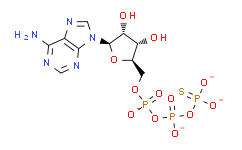

| 中文名称 |
ATPγS tetralithium salt
|
|---|---|
| 中文别名 |
5'-(Γ-硫代)三磷酸腺苷四锂盐;5''-(Γ-硫代)三磷酸腺苷四锂盐;5'-O-(3-硫代)三磷酸腺苷四锂盐;腺苷-5ˊ-(γ-硫代)三磷酸四锂盐;腺苷-5’-[γ-硫]三磷酸三锂盐;腺苷-5'-O-(3-硫代三磷酸)四锂盐;乙烯基磷酸二甲酯
|
| 英文名称 |
ATPγS tetralithium salt
|
| 英文别名 |
Adenosine5'-(trihydrogen diphosphate), P'-anhydride with phosphorothioic acid, lithiumsalt (1:4);Adenosine 5-O-(3-Thiotriphosphate), Tetralithium Salt;Adenosine 5'-(γ-thio)-triphosphate (lithium salt);Adenosine 5′-[γ-thio]triphosphate tetralithium salt;Adenosine5'-(trihydrogen diphosphate), P'-anhydride with phosphorothioic acid, lithiumsalt (1:...;ADENOSINE-5'-O-(3-THIOTRIPHOSPHATE);ATPγS tetralithium salt;ATPγS tetralithium salt,Adenosine-5'-(γ-thio)-triphosphatetetralithiumsalt;ATP-γ-S;Adenosine 5′-(3-thiotriphosphate) tetralithium salt;Ado-5′-PPP[S];adenosine-5′-o-(3-thio-triphosphate), tetralithium salt;Adenosine5'-(trihydrogen diphosphate), P'-anhydride with phosphorothioic acid,tetralithium salt (9CI);Adenosine 5'-(trihydrogen diphosphate), P'-anhydride with phosphorothioic acid, lithium salt (1:4)
|
| Cas No. |
93839-89-5
|
| 分子式 |
C10H12N5O12P3S-4
|
| 分子量 |
519.22
|
| 包装储存 |
Sealed and stored at -20℃, moisture-proof *In solvent : -80°C, 6 months; -20°C, 1 month (sealed storage, away from moisture) |
| 详情描述 |
P2嘌呤能受体激动剂,ATPγS tetralithium salt is an analogue of ATP, acting as a potent agonist of G protein-coupled P2Y2 and P2Y11 receptors (pEC50 = 5.52 for P2Y11) [1]. |
| 生物活性 |
ATPγS (tetralithium salt) is a substrate for the nucleotide hydrolysis and RNA unwinding activities of eukaryotic translation initiation factor eIF4A. |
|---|---|
| 性状 |
Solid |
| 体外研究(In Vitro) |
ATPγS (tetralithium salt) enhances intrinsic fluorescence and induces aggregation which increases the activity of spinach Rubisco activase. Medlife has not independently confirmed the accuracy of these methods. They are for reference only. |
| 体内研究(In Vivo) |
ATPγS (tetralithium salt, 50 μM final, intravenous) demonstrates preserved lung parenchymal architecture. Medlife has not independently confirmed the accuracy of these methods. They are for reference only. |
| 运输条件 |
Room temperature or refrigerated transportation. |
| 储存方式 |
Sealed and stored at -20℃, moisture-proof *In solvent : -80°C, 6 months; -20°C, 1 month (sealed storage, away from moisture) |
| 参考文献 |
|
| 溶解度数据 |
体外研究:
H2O : 125 mg/mL (228.53 mM; Need ultrasonic) 配制储备溶液
*
产品不同,其溶解度不同。建议根据产品选择合适的溶剂配制储备溶液;配成溶液后,建议分装保存,避免反复冻融造成的产品失效。 |
|---|
[1]. Matthew L Peck, et al. Adenosine 5-O-(3-thio)triphosphate (ATPgammaS) is a substrate for the nucleotide hydrolysis and RNA unwinding activities of eukaryotic translation initiation factor eIF4A. RNA. 2003 Oct;9(10):1180-7. [Information]
[2]. Z Y Wang, et al. Mg2+ and ATP or adenosine 5-[gamma-thio]-triphosphate (ATP gamma S) enhances intrinsic fluorescence and induces aggregation which increases the activity of spinach Rubisco activase. Biochim Biophys Acta. 1993 Sep 3;1202(1):47-55. [Information]
[3]. Irina A Kolosova, et al. Protective effect of purinergic agonist ATPgammaS against acute lung injury. Am J Physiol Lung Cell Mol Physiol. 2008 Feb;294(2):L319-24. [Information]
1:一般建议:溶解度为Medlife测试数据,可能与文献描述存在差异。这是由于生产工艺和批次不同产生的正常现象。为了使其更好的溶解,请用37℃加热试管并在超声波水浴中震动片刻。不同批次产品溶解度各有差异,仅做参考,具体以实验方案为准。
2:储存条件:粉末-20°C一般情况可以保存3年,溶于溶剂-80°C一般情况可以保存1年。不同产品及不同批次产品可能存在差异,请细致阅读产品信息,并辅助参考相关文献描述。
Copyright © 2025 陌孚医药 All rights reserved 未经授权禁止拷贝本站所有资料,如有违反,将追究法律责任。
 沪ICP备2023012080号 |
  沪公网安备31011402010657号
 扫码关注公众号

 产品使用指南
