
购物车0
产品总数:56378
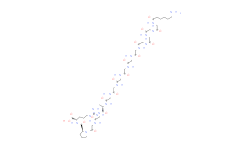


| 中文名称 |
Cecropin P1, porcine
|
|---|---|
| 中文别名 |
蛔虫抗菌肽P1
|
| 英文名称 |
Cecropin P1, porcine
|
| 英文别名 |
L-Arginine, L-seryl-L-tryptophyl-L-leucyl-L-seryl-L-lysyl-L-threonyl-L-alanyl-L-lysyl-L-lysyl-L-leucyl-L-a-glutamyl-L-asparaginyl-L-seryl-L-alanyl-L-lysyl-L-lysyl-L-arginyl-L-isoleucyl-L-seryl-L-a-glutamylglycyl-L-isoleucyl-L-alanyl-L-isoleucyl-L-alanyl-L-isoleucyl-L-glutaminylglycylglycyl-L-prolyl-;Cecropin P1;Cecropin P1 (porcine);L-Arginine, L-seryl-L-tryptophyl-L-leucyl-L-seryl-L-lysyl-L-threonyl-L-alanyl-L-lysyl-L-lysyl-...;L-Arginine, L-seryl-L-tryptophyl-L-leucyl-L-seryl-L-lysyl-L-threonyl-L-alanyl-L-lysyl-L-lysyl-L-leucyl-L-a-glutamyl-L-asparag;L-Arginine, L-seryl-L-tryptophyl-L-leucyl-L-seryl-L-lysyl-L-threonyl-L-alanyl-L-lysyl-L-lysyl-L-leucyl-L-a-glutamyl-L-asparaginyl-L-seryl-L-alanyl-L-lysyl-L-lysyl-L-arginyl-L-isoleucyl-L-seryl-L-a-glu;SER-TRP-LEU-SER-LYS-THR-ALA-LYS-LYS-LEU-GLU-ASN-SER-ALA-LYS-LYS-ARG-ILE-SER-GLU-GLY-ILE-ALA-ILE-ALA-ILE-GLN-GLY-GLY-PRO-ARG;cecropin P1-LI;Porcine cecropin;Aids096086;Aids-096086;H-SER-TRP-LEU-SER-LYS-THR-ALA-LYS-LYS-LEU-GLU-ASN-SER-ALA-LYS-LYS-ARG-ILE-SER-GLU-GLY-ILE-ALA-ILE-ALA-ILE-GLN-GLY-GLY-PRO-ARG-OH;Cecropin P1 Porcine;NV7O3PE13N;cecropin P1;CECROPIN P1 (PORCINE)
|
| Cas No. |
125667-96-1
|
| 分子式 |
C147H253N45O43
|
| 分子量 |
3338.86
|
| 包装储存 |
Sealed storage, away from moisture and light, under nitrogenPowder -80°C 2 years;-20°C 1 ye
|
| 详情描述 |
Cecropin P1, porcine 是一种抗菌 (antibacterial) 肽,可从猪小肠上部分离。Cecropin P1, porcine 对革兰氏阴性菌具有抗菌活性。Cecropin P1, porcine 具有抗病毒 (antiviral) 活性,可抑制 PRRSV 感染。
|
| 产品详情 |
Cecropin P1, porcine 是一种抗菌 (antibacterial) 肽,可从猪小肠上部分离。Cecropin P1, porcine 对革兰氏阴性菌具有抗菌活性。Cecropin P1, porcine 具有抗病毒 (antiviral) 活性,可抑制 PRRSV 感染。
|
|---|---|
| 生物活性 |
Cecropin P1, porcine is an antibacterial peptide that can be isolated from the upper part of the small intestine of the pig. Cecropin P1, porcine shows antibacterial activity against Gram-negative bacteria. Cecropin P1, porcine shows antiviral activity and inhibits PRRSV infection.
|
| 性状 |
Solid
|
| 体外研究(In Vitro) |
Cecropin P1, porcine (0-480 μg/mL, 36-96 h) markedly inhibits CH-1a infection and replication in Marc-145 cells.Cecropin P1, porcine (0-480 μg/mL, 36 h) not only displays extracellular virucidal activity against PRRSV (porcine reproductive and respiratory syndrome virus), but also exerts a potent inhibitory effect when added either before, simultaneously with, or after viral inoculation. Cecropin P1, porcine (480 μg/mL, 0-72 h) blocks CH-1a-induced apoptosis during the late phase of infection.Cecropin P1, porcine (0-480 μg/mL, 0-4 h) inhibits viral particle release. has not independently confirmed the accuracy of these methods. They are for reference only.
|
| 体内研究(In Vivo) |
Cecropin P1 (1 mg/kg, IP, once) prevents bacterial growth, endotoxemia, and mortality in rats with septic shock. has not independently confirmed the accuracy of these methods. They are for reference only.
|
| 运输条件 |
Room temperature in continental US; may vary elsewhere.
|
| 储存方式 |
Sealed storage, away from moisture and light, under nitrogenPowder -80°C 2 years;-20°C 1 ye
|
| SequenceShortening |
SWLSKTAKKLENSAKKRISEGIAIAIQGGPR
|
| Sequence |
Ser-Trp-Leu-Ser-Lys-Thr-Ala-Lys-Lys-Leu-Glu-Asn-Ser-Ala-Lys-Lys-Arg-Ile-Ser-Glu-Gly-Ile-Ala-Ile-Ala-Ile-Gln-Gly-Gly-Pro-Arg
|
| 参考文献 |
[1]. Andersson M, et al. Ascaris nematodes from pig and human make three antibacterial peptides: isolation of cecropin P1 and two ASABF peptides. Cell Mol Life Sci. 2003 Mar;60(3):599-606. [2]. Guo C, et al. Cecropin P1 inhibits porcine reproductive and respiratory syndrome virus by blocking attachment. BMC Microbiol. 2014 Nov 18;14:273.
|
| 溶解度数据 |
In Vitro: H2O : 50 mg/mL (14.98 mM; Need ultrasonic)配制储备液
|
|---|
1:一般建议:溶解度为Medlife测试数据,可能与文献描述存在差异。这是由于生产工艺和批次不同产生的正常现象。为了使其更好的溶解,请用37℃加热试管并在超声波水浴中震动片刻。不同批次产品溶解度各有差异,仅做参考,具体以实验方案为准。
2:储存条件:粉末-20°C一般情况可以保存3年,溶于溶剂-80°C一般情况可以保存1年。不同产品及不同批次产品可能存在差异,请细致阅读产品信息,并辅助参考相关文献描述。
Copyright © 2025 陌孚医药 All rights reserved 未经授权禁止拷贝本站所有资料,如有违反,将追究法律责任。
 沪ICP备2023012080号 |
  沪公网安备31011402010657号
 扫码关注公众号
 产品使用指南
