
购物车0
产品总数:56378
| 商品编号 | 规格 | 价格 | 会员价 | 是否有货 | 数量 |
|---|---|---|---|---|---|
| PL09401-5mg | 5mg | ¥793.00 | 请登录 |
|
|
| PL09401-10mg | 10mg | ¥1265.00 | 请登录 |
|
|
| PL09401-25mg | 25mg | ¥2605.00 | 请登录 |
|
|
| PL09401-50mg | 50mg | ¥3905.00 | 请登录 |
|
|
| PL09401-100mg | 100mg | ¥5865.00 | 请登录 |
|


| 中文名称 |
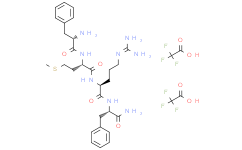
Phe-Met-Arg-Phe amide trifluoroacetate
|
|---|---|
| 英文名称 |
Phe-Met-Arg-Phe amide trifluoroacetate
|
| 英文别名 |
Phe-Met-Arg-Phe amide trifluoroacetate;Phe-Met-Arg-Phe amide (trifluoroacetate)
|
| Cas No. |
159237-99-7
|
| 分子式 |
C33H44F6N8O8S
|
| 分子量 |
826.81
|
| 包装储存 |
Sealed storage, away from moisturePowder -80°C 2 years;-20°C 1 year
|
| 详情描述 |
Phe-Met-Arg-Phe amide trifluoroacetate 是一种神经肽,在肽能神经元中激活 K+ 电流,ED50 为 23 nM,这种作用具有剂量依赖性。
|
| 产品详情 |
Phe-Met-Arg-Phe amide trifluoroacetate 是一种神经肽,在肽能神经元中激活 K+ 电流,ED50 为 23 nM,这种作用具有剂量依赖性。
|
|---|---|
| 生物活性 |
Phe-Met-Arg-Phe amide trifluoroacetate is an activator of K current, with ED 50 of 23 nM in the peptidergic caudodorsal neurons.
|
| 性状 |
Solid
|
| IC50 & Target[1][2] |
ED50: 23 nM (K current)
|
| 体外研究(In Vitro) |
In the molluscan central nervous system, Phe-Met-Arg-Phe amide (FMRFa) acts on K channels in sensory, motor-, and neuroendocrine neurones. Phe-Met-Arg-Phe amide activates a novel K current that is characterized by a combined voltage- and receptor-dependent gating mechanism, with both factors being necessary for opening of the channels. Phe-Met-Arg-Phe amide (1 μM) significantly inhibits glucose stimulated (300 mg/dL) insulin release (p<0.005) and somatostatin release (p<0.01) from the isolated perfused pancreas. Phe-Met-Arg-Phe amide (FMRF-NH2) (1 and 10 μM) is without effect on glucagon secretion, either in low glucose (50 mg/dL), high glucose (300 mg/dL), or during arginine stimulation (5 mM). has not independently confirmed the accuracy of these methods. They are for reference only.
|
| 体内研究(In Vivo) |
Phe-Met-Arg-Phe amide (FMRFamide) stimulates growth hormone secretion in conscious OVX rats. The presence of Phe-Met-Arg-Phe amide-like immunoreactivity in neuronal elements in the hypothalamus suggested a role for this in the hypothalamic control of the anterior pituitary function. The injection of 200 ng (313.8 picomoles) of FMRFamide (in 2 uL) produces a significantly increased plasma GH 15 min after injection. The GH-increasing effect of 400-800 ng (627-1255 picomoles) of FMRFamide is already developed after 5 min and lasted up to 30 min. has not independently confirmed the accuracy of these methods. They are for reference only.
|
| 运输条件 |
Room temperature in continental US; may vary elsewhere.
|
| 储存方式 |
Sealed storage, away from moisturePowder -80°C 2 years;-20°C 1 year
|
| SequenceShortening |
FMRF-NH2
|
| Sequence |
Phe-Met-Arg-Phe-NH2
|
| 参考文献 |
[1]. Kits KS, et al. Phe-Met-Arg-Phe-amide activates a novel voltage-dependent K+ current through a lipoxygenasepathway in molluscan neurones. J Gen Physiol. 1997 Nov;110(5):611-28.[2]. Sorenson RL, et al. Phe-met-arg-phe-amide (FMRF-NH2) inhibits insulin and somatostatin secretion and anti-FMRF-NH2 sera detects pancreatic polypeptide cells in the rat islet. Peptides. 1984 Jul-Aug;5(4):777-82.
|
| 溶解度数据 |
In Vitro: DMSO : 100 mg/mL (120.95 mM; Need ultrasonic)H2O : 20 mg/mL (24.19 mM; Need ultrasonic)配制储备液
|
|---|
1:一般建议:溶解度为Medlife测试数据,可能与文献描述存在差异。这是由于生产工艺和批次不同产生的正常现象。为了使其更好的溶解,请用37℃加热试管并在超声波水浴中震动片刻。不同批次产品溶解度各有差异,仅做参考,具体以实验方案为准。
2:储存条件:粉末-20°C一般情况可以保存3年,溶于溶剂-80°C一般情况可以保存1年。不同产品及不同批次产品可能存在差异,请细致阅读产品信息,并辅助参考相关文献描述。
Copyright © 2025 陌孚医药 All rights reserved 未经授权禁止拷贝本站所有资料,如有违反,将追究法律责任。
 沪ICP备2023012080号 |
  沪公网安备31011402010657号
 扫码关注公众号
 产品使用指南
