
购物车0
产品总数:56378


| 中文名称 |
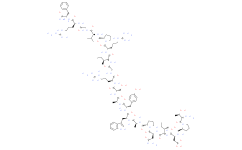
Prolactin Releasing Peptide (12-31), human
|
|---|---|
| 中文别名 |
12-31-人催乳素释放肽
|
| 英文名称 |
Prolactin Releasing Peptide (12-31), human
|
| 英文别名 |
Prolactin-Releasing Peptide (12-31) (human);Prolactin-releasing Peptide human;PREPROLACTIN (34-53) (HUMAN);Prolactin-Releasing Peptide (12-31) (human), PrRP20 (human), Preprolactin (34-53) (human);THR-PRO-ASP-ILE-ASN-PRO-ALA-TRP-TYR-ALA-SER-ARG-GLY-ILE-ARG-PRO-VAL-GLY-ARG-PHE-NH2;Prolactin-releasing peptide-20 (human);(3S)-4-[[(2S,3S)-1-[[(2S)-4-Amino-1-[(2S)-2-[[(2S)-1-[[(2S)-1-[[(2S)-1-[[(2S)-1-[[(2S)-1-[[(2S)-1-[[;Prolactin Releasing Peptide (12-31), human
|
| Cas No. |
235433-36-0
|
| 分子式 |
C104H158N32O26
|
| 分子量 |
2272.57
|
| 包装储存 |
Sealed storage, away from moisture and light, under nitrogenPowder -80°C 2 years;-20°C 1 ye
|
| 详情描述 |
Prolactin Releasing Peptide (12-31), human是催乳素释放肽的片段。Prolactin Releasing Peptide (1-31), human是高亲和力的 GPR10 配体,其引起催乳素的释放。
|
| 产品详情 |
Prolactin Releasing Peptide (12-31), human是催乳素释放肽的片段。Prolactin Releasing Peptide (1-31), human是高亲和力的 GPR10 配体,其引起催乳素的释放。
|
|---|---|
| 生物活性 |
Prolactin Releasing Peptide (12-31), human is a fragment of the prolactin releasing peptide (PrRP). Prolactin Releasing Peptide (1-31), human is a high affinity GPR10 ligand that cause the release of the prolactin.
|
| 性状 |
Solid
|
| IC50 & Target[1][2] |
GPR10
|
| 体外研究(In Vitro) |
The Prolactin Releasing Peptide (PrRP) is a C-terminally amidated, 31-amino acid peptide derived from a 98-amino acid precursor. Radioiodinated PrRP-(1-31) binds to its receptor with high affinity (1 nM) and stimulates calcium mobilization in CHOK1 cells stably transfected with the receptor. A series of N-terminal deletions reveals that the Prolactin Releasing Peptide (12-31) amino acid is equipotent to PrRP-(1-31). Further N-terminal deletions reduce the affinity of the ligand considerably. Prolactin Releasing Peptide (PrRP) has been identified as a specific, high affinity endogenous ligand for GPR10. Prolactin Releasing Peptide (PrRP) preproprotein can be cleaved at two different positions to give rise to two forms of 31 or 20 amino acids; Prolactin Releasing Peptide (PrRP)-31 and Prolactin Releasing Peptide (PrRP)-20 respectively. Rat Prolactin Releasing Peptide (PrRP) has
|
| 体内研究(In Vivo) |
Following intracerebroventricular injection of Prolactin Releasing Peptide (1-31), human 5 nM there is a highly significant simulation of plasma LH that began at 10 minutes and is maintained over the course of the experiment. Plasma FSH increased at 20 minutes following ICV injection. Total plasma testosterone increased at 60 minutes post injection. has not independently confirmed the accuracy of these methods. They are for reference only.
|
| 运输条件 |
Room temperature in continental US; may vary elsewhere.
|
| 储存方式 |
Sealed storage, away from moisture and light, under nitrogenPowder -80°C 2 years;-20°C 1 ye
|
| SequenceShortening |
TPDINPAWYASRGIRPVGRF-NH2
|
| Sequence |
Thr-Pro-Asp-Ile-Asn-Pro-Ala-Trp-Tyr-Ala-Ser-Arg-Gly-Ile-Arg-Pro-Val-Gly-Arg-Phe-NH2
|
| Solvent&Solubility |
In Vitro:
H2O Peptide Solubility and Storage Guidelines:1. Calculate the length of the peptide.2. Calculate the overall charge of the entire peptide according to the following table: |
| 参考文献 |
[1]. Roland BL, et al. Anatomical distribution of prolactin-releasing peptide and its receptor suggests additional functions in the central nervous system and periphery. Endocrinology. 1999 Dec;140(12):5736-45.[2]. Langmead CJ, et al. Characterization of the binding of [(125)I]-human prolactin releasing peptide (PrRP) to GPR10, a novel G protein coupled receptor. Br J Pharmacol. 2000 Oct;131(4):683-8.
|
1:一般建议:溶解度为Medlife测试数据,可能与文献描述存在差异。这是由于生产工艺和批次不同产生的正常现象。为了使其更好的溶解,请用37℃加热试管并在超声波水浴中震动片刻。不同批次产品溶解度各有差异,仅做参考,具体以实验方案为准。
2:储存条件:粉末-20°C一般情况可以保存3年,溶于溶剂-80°C一般情况可以保存1年。不同产品及不同批次产品可能存在差异,请细致阅读产品信息,并辅助参考相关文献描述。
Copyright © 2025 陌孚医药 All rights reserved 未经授权禁止拷贝本站所有资料,如有违反,将追究法律责任。
 沪ICP备2023012080号 |
  沪公网安备31011402010657号
 扫码关注公众号
 产品使用指南
