
购物车0
产品总数:61739
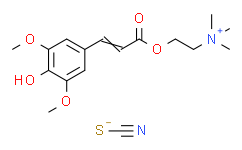


| 中文名称 |
Sinapine thiocyanate
|
|---|---|
| 中文别名 |
芥子碱硫氰酸盐;Sinapine thiocyanate 芥子碱硫氰酸盐 标准品;芥子碱硫氰酸盐,Sinapine thiocyanate,植物提取物,标准品,对照品;芥子碱硫氰酸盐对照品;芥子碱硫氰酸盐,Sinapine thiocyanate
|
| 英文名称 |
Sinapine thiocyanate
|
| 英文别名 |
2-((3-(4-Hydroxy-2,5-dimethoxyphenyl)acryloyl)oxy)-N,N,N-trimethylethanaminium thiocyanate;Sinapine thiocyanate;Sinapine (thiocyanate);ST24038959
|
| Cas No. |
7431-77-8
|
| 分子式 |
C17H24N2O5S
|
| 分子量 |
368.45
|
| 包装储存 |
4°C, Sealed and stored away from moisture and light;*In solvent : -80°C, 6 months; -20°C, 1 month (Sealed and stored away from moisture and light);
|
| 详情描述 |
Sinapine thiocyanate 是一种从十字花科物种的种子中分离出来的生物碱。Sinapine thiocyanate 具有抗炎,抗氧化,抗肿瘤,抗血管生成和放射防护作用。Sinapine thiocyanate 还是一种乙酰胆碱酯酶 (AChE) 抑制剂,可用于研究阿尔茨海默症,共济失调,重症肌无力和帕金森氏病。Sinapine thiocyanate 是一种从十字花科物种的种子中分离出来的生物碱。Sinapine thiocyanate 具有抗炎,抗氧化,抗肿瘤,抗血管生成和放射防护作用。Sinapine thiocyanate 还是一种乙酰胆碱酯酶 (AChE) 抑制剂,可用于研究阿尔茨海默症,共济失调,重症肌无力和帕金森氏病。
|
| 生物活性 |
Sinapine thiocyanate is an alkaloid isolated from seeds of the cruciferous species. Sinapine thiocyanate exhibits anti-inflammatory, anti-oxidant, anti-tumor, anti-angiogenic and radio-protective effects. Sinapine thiocyanate is also an acetylcholinesterase (AChE) inhibitor and can be used for the research of Alzheimer’s disease, ataxia, myasthenia gravis, and Parkinson’s disease.
|
|---|---|
| 性状 |
Solid
|
| IC50 & Target[1][2] |
AChE |
| 溶解度数据 |
体外研究:DMSO : 50 mg/mL(135.70 mM;Need ultrasonic)配制储存液
|
|---|
1:一般建议:溶解度为Medlife测试数据,可能与文献描述存在差异。这是由于生产工艺和批次不同产生的正常现象。为了使其更好的溶解,请用37℃加热试管并在超声波水浴中震动片刻。不同批次产品溶解度各有差异,仅做参考,具体以实验方案为准。
2:储存条件:粉末-20°C一般情况可以保存3年,溶于溶剂-80°C一般情况可以保存1年。不同产品及不同批次产品可能存在差异,请细致阅读产品信息,并辅助参考相关文献描述。
Copyright © 2025 陌孚医药 All rights reserved 未经授权禁止拷贝本站所有资料,如有违反,将追究法律责任。
 沪ICP备2023012080号 |
  沪公网安备31011402010657号
 扫码关注公众号
 产品使用指南
