
购物车0
产品总数:61739
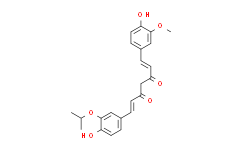


| 中文名称 |
Dimethylcurcumin
|
|---|---|
| 中文别名 |
二甲基姜黄素;四甲基姜黄素
|
| 英文名称 |
Dimethylcurcumin
|
| 英文别名 |
Dimethylcurcumin;ASC-J9;(1E,4Z,6E)-1,7-Bis(3,4-dimethoxyphenyl)-5-hydroxy-1,4,6-heptatrie n-3-one;1,4,6-Heptatrien-3-one, 1,7-bis(3,4-dimethoxyphenyl)-5-hydroxy-,(1E,4Z,6E)-;ASC J9;GO Y025;GO-Y025
|
| Cas No. |
52328-98-0
|
| 分子式 |
C23H24O6
|
| 分子量 |
396.43
|
| 包装储存 |
Powder; -20°C; 3 years; 4°C; 2 years;
|
| 详情描述 |
Dimethylcurcumin (ASC-J9) 是一种雄激素受体降解增强剂,可有效抑制耐药性前列腺癌细胞增殖和侵袭。Dimethylcurcumin (ASC-J9) 是一种雄激素受体降解增强剂,可有效抑制耐药性前列腺癌细胞增殖和侵袭。
|
| 生物活性 |
Dimethylcurcumin (ASC-J9) is an androgen receptor degradation enhancer that effectively suppresses castration resistant prostate cancer cell proliferation and invasion.
|
|---|---|
| 性状 |
Solid
|
| 体外研究(In Vitro) |
Dimethylcurcumin (ASC-J9) is able to degrade fAR and AR3 in a dose-dependent manner in various human PCa cells. Dimethylcurcumin (ASC-J9) can also effectively suppress AR-targeted genes in CWR22Rv1-fARKD cells. Dimethylcurcumin (ASC-J9) (5 or 10 μM) significantly suppresses the DHT-induced cell growth in all three PCa cell lines. Dimethylcurcumin (ASC-J9) suppresses AR-targeted genes and cell growth by degradation of fAR and ectopic AR3 in C81 and C4-2 cells. Dimethylcurcumin (ASC-J9) selectively promotes AR degradation by disrupting the interaction between AR and AR coregulators. ASC-J9 reduces the AR aggregated AR-112Q in cells. Dimethylcurcumin (ASC-J9) suppresses the aggregation of AR-112Q in SBMA PC12/AR-112Q cells.Medlife has not independently confirmed the accuracy of these methods. They are for reference only.
|
| 体内研究(In Vivo) |
Dimethylcurcumin (ASC-J9) (75 mg/kg, i.p.) degrades both fAR and AR3 in the xenografted tumors in vivo, and SC-J9-treated tumors has significantly decreased Ki67-positive cells. Dimethylcurcumin (ASC-J9) (50 mg/kg every 48 h, i.p.) substantially ameliorates the SBMA symptoms in AR-97Q mice, and ameliorates neuromuscular pathological findings. The Dimethylcurcumin (ASC-J9)-treated SBMA mice have relatively normal serum testosterone concentrations. ASC-J9-treated mice show significantly smaller prostate tumor sizes when compared with those receiving classic ADT/castration with little serum androgen.Medlife has not independently confirmed the accuracy of these methods. They are for reference only.
|
| 运输条件 |
Room temperature or refrigerated transport.
|
| 储存方式 |
Powder; -20°C; 3 years; 4°C; 2 years;
|
| ClinicalTrial |
|
| 结构分类 |
Phenylpropanoids
|
| 来源 |
Plants
|
| 溶解度数据 |
体外研究:DMSO : ≥ 50 mg/mL(126.13 mM)*≥ means soluble, but saturation unknown. 配制储存液
|
|---|
1:一般建议:溶解度为Medlife测试数据,可能与文献描述存在差异。这是由于生产工艺和批次不同产生的正常现象。为了使其更好的溶解,请用37℃加热试管并在超声波水浴中震动片刻。不同批次产品溶解度各有差异,仅做参考,具体以实验方案为准。
2:储存条件:粉末-20°C一般情况可以保存3年,溶于溶剂-80°C一般情况可以保存1年。不同产品及不同批次产品可能存在差异,请细致阅读产品信息,并辅助参考相关文献描述。
Copyright © 2025 陌孚医药 All rights reserved 未经授权禁止拷贝本站所有资料,如有违反,将追究法律责任。
 沪ICP备2023012080号 |
  沪公网安备31011402010657号
 扫码关注公众号
 产品使用指南
